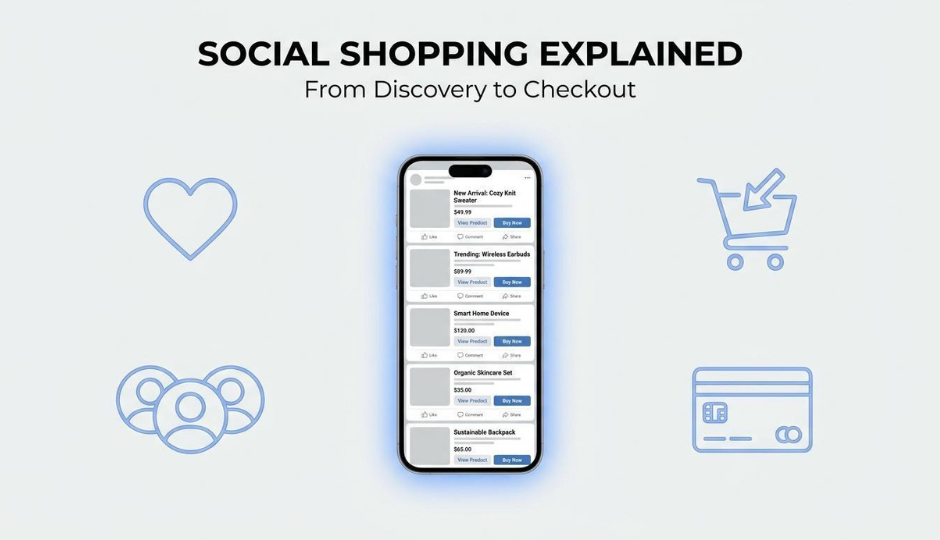
Social shopping is the process of discovering, evaluating, and purchasing products through social media interactions, where peer recommendations, creator content, and in-feed storefronts replace the traditional ecommerce browsing experience.
This guide covers the distinction between social shopping and social commerce, the measurable benefits for DTC brands, the platforms and features driving the most sales, strategy best practices and common mistakes, and how social shopping fits into a unified omnichannel operation.
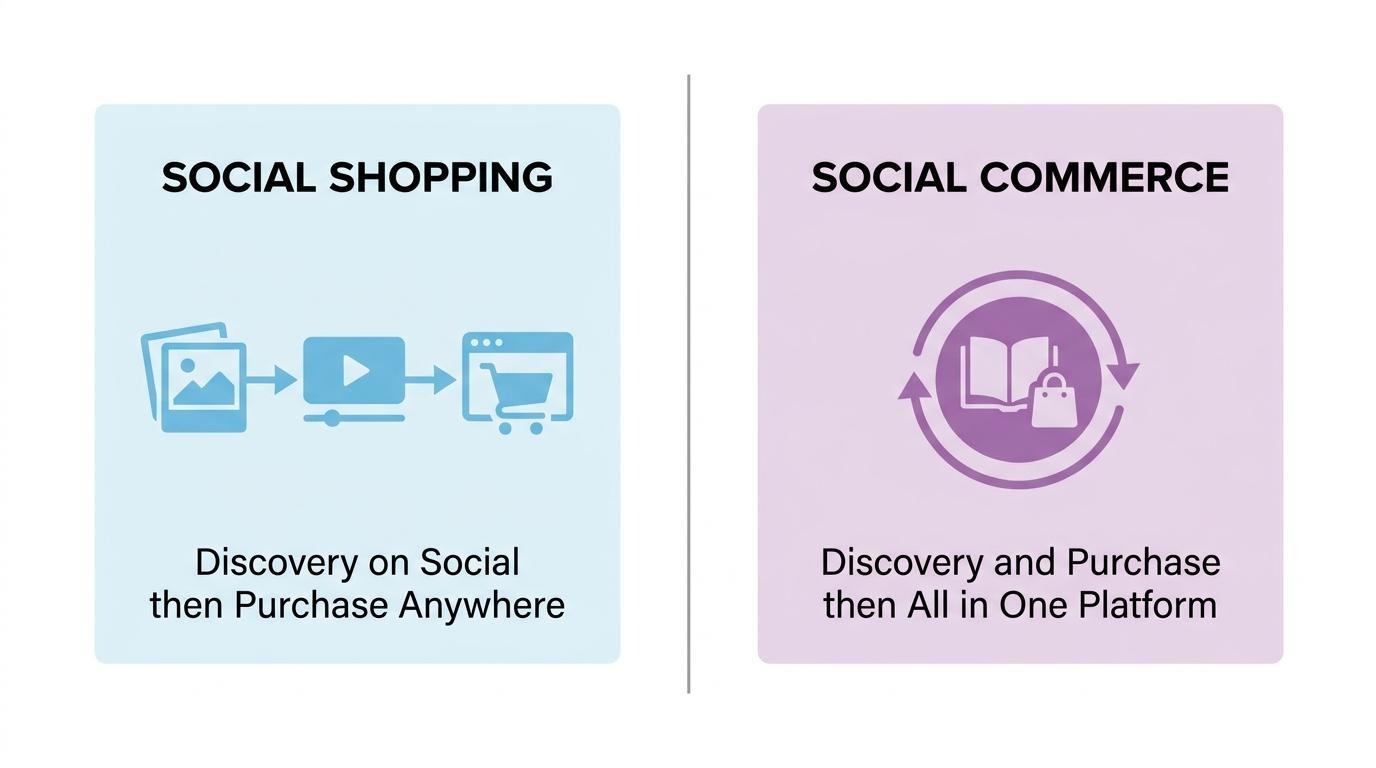
Social shopping and social commerce are related but not interchangeable. Social shopping encompasses any purchase behavior influenced by social interactions across multiple touchpoints, while social commerce confines the entire transaction to a single platform. Understanding this boundary helps brands allocate budgets accurately and avoid attribution blind spots.
For DTC brands, the benefits are concrete and compounding. Social channels compress the journey from discovery to checkout into minutes rather than hours, and customers acquired through social commerce consistently show higher lifetime value. User-generated content and peer reviews serve as conversion multipliers that outperform polished brand advertising.
Each major platform serves different buyer behaviors. TikTok Shop leads in purchase frequency and impulse-driven sales, Instagram Shopping dominates visual discovery for fashion and beauty, Facebook Shops reaches older demographics through conversational commerce, and Pinterest and YouTube capture high-intent browsers and long-form consideration shoppers respectively. Pairing the right platform with the right features (shoppable tags, live shopping, UGC feeds, in-app checkout) determines whether social content actually converts.
Operationally, the biggest risks are unsynchronized product catalogs, neglected post-purchase engagement, and fragmented tool stacks that create data silos between channels. Brands scaling across multiple social storefronts need real-time inventory sync, consistent pricing, and unified customer profiles to prevent the compounding errors that erode both trust and margin.
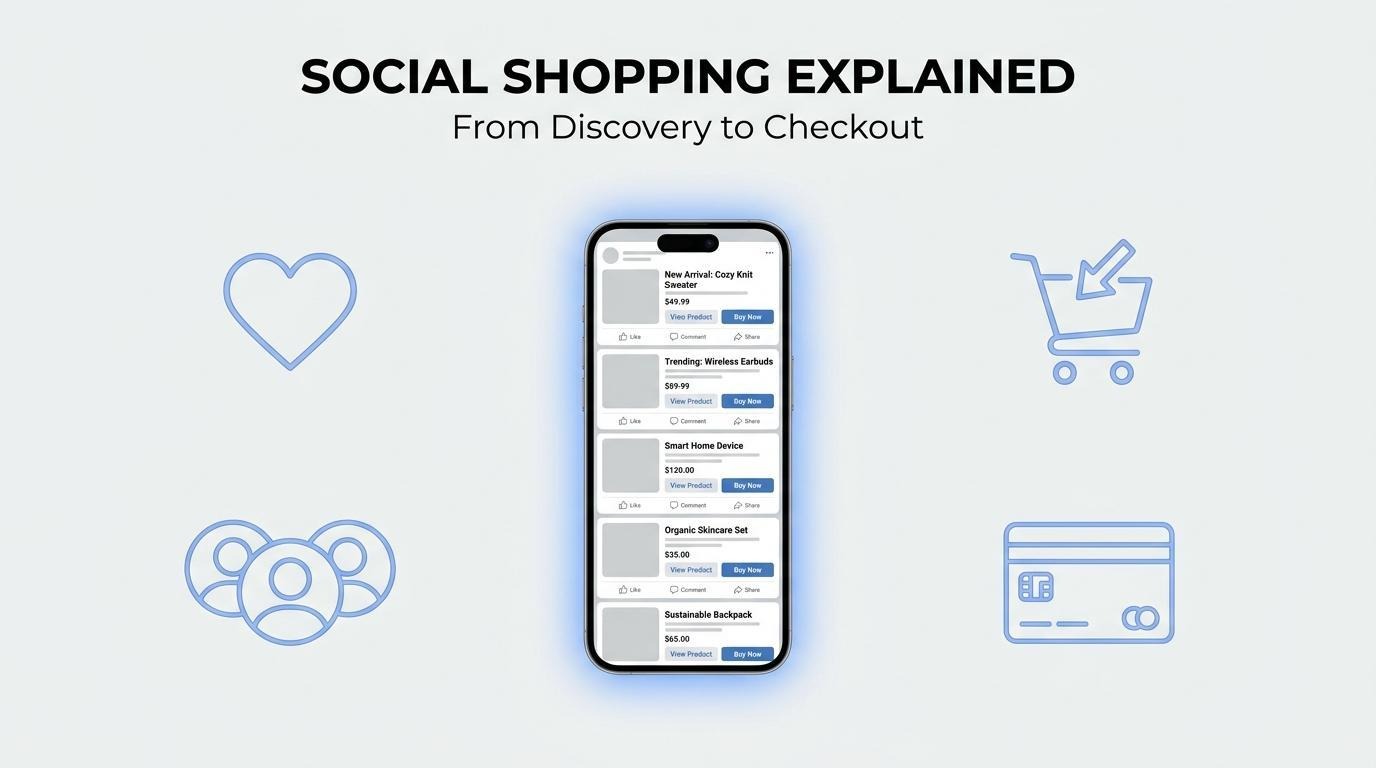
Social shopping differs from social commerce in where the transaction completes. Social shopping encompasses the broader experience of discovering, sharing, and evaluating products through social interactions, while social commerce confines the entire purchase journey to a single platform. Below, the distinction becomes clearer when examining how each model works and the market forces driving their convergence.
Social shopping refers to any buying behavior influenced by social interactions, such as reading peer reviews, browsing curated collections from creators, or clicking a product link shared in a group chat. The buyer may discover a product on Instagram but complete checkout on a brand's own website. Social commerce, by contrast, keeps every step contained. According to Accenture, social commerce means a person's entire shopping experience, from product discovery to the checkout process, takes place on a social media platform. That end-to-end containment is the defining line.
The scale of in-platform purchasing underscores why the distinction matters. US social commerce sales rose 26% in 2024 to $71.62 billion, per eMarketer, and are projected to surpass $100 billion for the first time in 2026. Platforms like TikTok Shop, Instagram Shopping, and Facebook Shops are each building native checkout flows that eliminate the redirect to an external store. Roughly 49.7% of social shoppers on TikTok buy something directly on the platform at least once per month, a frequency higher than on Facebook, Instagram, or Pinterest.
For brands selling at scale, this convergence creates a practical challenge: social shopping generates demand across many touchpoints, while social commerce centralizes transactions inside walled gardens. Managing both requires synchronized product catalogs, consistent pricing, and unified customer data, because a shopper who discovers a product socially may convert on any channel. Treating these as interchangeable terms leads to misallocated budgets and blind spots in attribution. Understanding where social influence ends and native-platform commerce begins is the first step toward building a strategy that captures revenue from both.
Social shopping has become so popular in the United States because of converging shifts in consumer behavior, platform technology, and mobile-first media consumption. Several factors drive this growth, including shorter attention spans favoring in-feed discovery, native checkout tools reducing purchase friction, the trust consumers place in peer recommendations over traditional ads, and the rise of algorithm-driven content that surfaces products at the moment of intent. According to eMarketer, US social commerce sales rose 26% in 2024 to $71.62 billion and are expected to reach $85.58 billion in 2025, surpassing $100 billion for the first time in 2026. That trajectory reflects a fundamental change in how American consumers find and buy products. Rather than navigating to a separate website, shoppers now complete purchases inside the same feed where they discover items, which collapses the traditional marketing funnel into a single interaction. Platforms like TikTok, Instagram, and Facebook have invested heavily in shoppable features, live commerce, and creator-affiliate programs that make buying feel like a natural extension of scrolling. For scaling DTC brands, this shift is especially significant because it opens acquisition channels where social proof, user-generated content, and community engagement do the selling, often at lower cost per acquisition than paid search or display. The sections ahead explore the specific benefits, platform dynamics, and best practices that make social shopping a strategic priority for ecommerce brands in the United States.
The key benefits of social shopping for DTC brands include shorter purchase paths, stronger social proof, lower acquisition costs, higher retention, and richer first-party data.
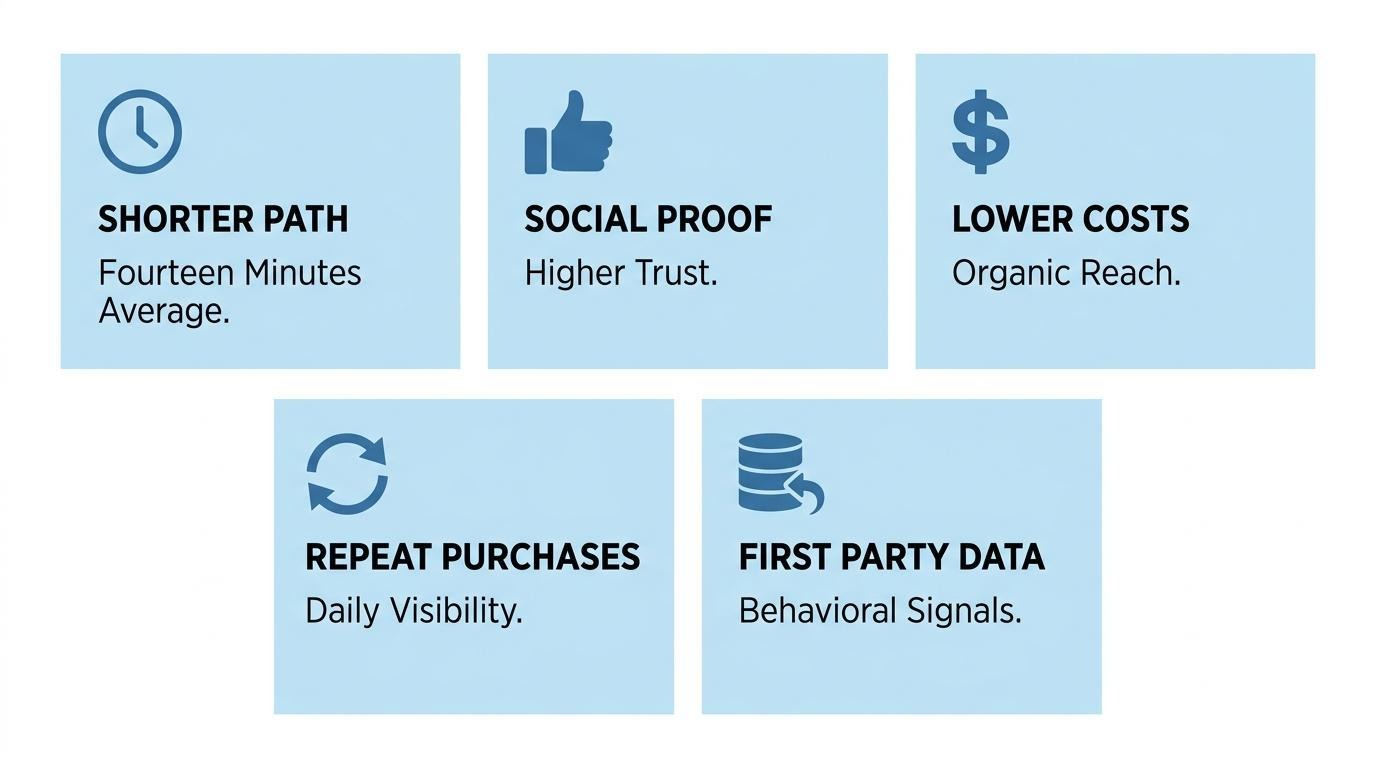
Social shopping shortens the path from discovery to purchase by embedding product listings, reviews, and checkout directly within the content feed. Shoppers move from awareness to transaction without leaving the platform, eliminating the redirect friction that traditional ecommerce sites impose.
According to ATTN Agency, the average time from discovery to purchase is 14 minutes on TikTok versus 4 hours on traditional ecommerce, and social commerce customers show 34% higher lifetime value compared to traditional acquisition channels. That compressed timeline matters because fewer steps mean fewer drop-off points. For DTC brands selling impulse-friendly products, this speed advantage is one of the highest-leverage shifts in modern ecommerce.
Social shopping increases customer trust through social proof by surfacing real-time reviews, tagged posts, and creator endorsements alongside the product itself. Buyers see how others use and react to a product before committing.
This trust mechanism is more nuanced than simply adding testimonials to a product page. According to ATTN Agency, 89% of DTC brands still approach social commerce like traditional ecommerce with a social media wrapper, completely missing the fundamental shift in how customers discover, evaluate, and purchase products. Brands that lean into authentic user content rather than polished ad creative tend to earn higher engagement. One compliance consideration: the FTC requires that endorsement messages make material connections with brands obvious, including during live streams where disclosures should be repeated periodically for partial viewers.
Social shopping improves customer acquisition costs by replacing interruption-based advertising with discovery-driven content. When a creator demonstrates a product in a natural context, the content functions simultaneously as entertainment, education, and sales funnel.
Organic creator content and shoppable posts generate clicks without the escalating bid costs of traditional paid social. Algorithmic distribution on platforms like TikTok and Instagram rewards high-engagement content with free reach, further reducing the cost per new customer. For DTC brands operating on tight margins, this organic amplification layer can meaningfully offset paid media spend.
Social shopping boosts repeat purchases and retention by keeping brands visible in feeds customers already check daily. Unlike email sequences that compete in crowded inboxes, social content resurfaces brands through algorithmic recommendations and community interactions.
Followers who engage with a brand's social storefront receive ongoing exposure to new product drops, restocks, and limited releases. This passive re-engagement loop is difficult to replicate through traditional retention channels alone. Brands that pair social content with consistent posting cadences create habitual touchpoints, turning one-time buyers into recurring customers without relying solely on discount-driven reactivation.
Social shopping generates first-party customer data by capturing behavioral signals directly from in-platform interactions. Every product view, save, share, comment, and purchase creates a data point tied to an identifiable user profile.
This data is especially valuable as third-party cookies phase out and paid targeting becomes less precise. Platform-native analytics reveal which content formats drive conversions, which products attract the most saves, and which audience segments engage most frequently. DTC brands can feed these insights back into product development, inventory planning, and ad targeting. For brands selling across multiple social channels, consolidating this data into a unified view becomes critical to making it actionable at scale.
The social shopping platforms that drive the most sales are TikTok Shop, Instagram Shopping, Facebook Shops, YouTube Shopping, and Pinterest Shopping. Each platform serves different buyer behaviors and product categories.
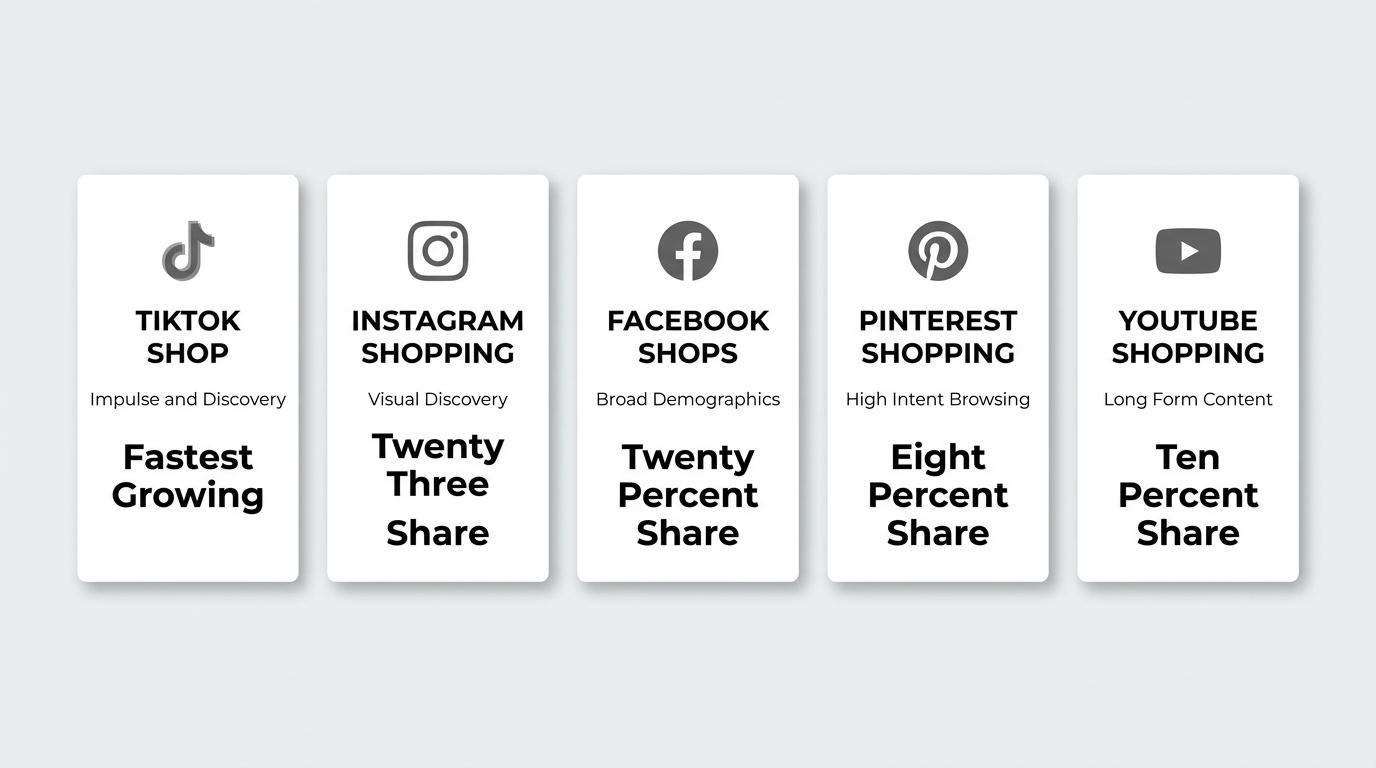
Instagram Shopping generates sales through visual product discovery. The platform lets brands tag products directly in feed posts, Stories, and Reels, turning browsing into buying without leaving the app. According to ATTN Agency's 2026 projections, Instagram Shopping is expected to capture 23% of the global social commerce market, translating to roughly $670 billion. Fashion, beauty, and lifestyle brands benefit most from Instagram's visually rich format. Shoppable posts paired with influencer content create a natural path from inspiration to checkout, which makes this platform especially effective for brands with strong visual identity.
TikTok Shop is the fastest-growing social shopping channel in the United States. According to eMarketer, roughly half (49.7%) of social shoppers on TikTok buy something from the platform at least once per month, more frequently than on Facebook, Instagram, or Pinterest. The platform's algorithm-driven discovery engine surfaces products to users who have never followed the brand, compressing the funnel dramatically. For DTC brands selling impulse-friendly products under $50, TikTok Shop often delivers the strongest return per dollar spent. Live shopping events and creator-affiliate programs amplify this effect further.
Facebook Shops reaches the broadest demographic of any social shopping platform. With projected 20% global market share by 2026, Facebook remains a high-volume channel despite shifting younger audiences to other platforms. The Shops feature integrates directly with Messenger and WhatsApp, enabling conversational commerce where customers can ask questions and complete purchases in the same thread. Brands targeting buyers aged 30 and older, particularly in home goods, food and beverage, and family-oriented categories, often find Facebook delivers consistent, if less flashy, returns compared to newer platforms.
Pinterest Shopping converts high-intent browsers into buyers. Unlike other platforms where users scroll passively, Pinterest users actively search for ideas and products they plan to purchase. The platform is projected to hold 8% of global social commerce share by 2026. Product Pins link directly to checkout, and the platform's visual search technology lets shoppers find items by uploading photos. This intent-rich environment suits brands in home decor, fashion, beauty, and wedding categories especially well. For brands with strong product photography, Pinterest often delivers a higher average order value than more impulse-driven channels.
YouTube Shopping turns long-form video content into a sales channel. The platform is projected to capture 10% of global social commerce share by 2026, reaching approximately $290 billion. Product shelves beneath videos and tagged products within content let viewers buy without interrupting their watching experience. Tutorial content, product reviews, and unboxing videos create extended consideration windows that suit higher-priced items. Brands selling electronics, fitness equipment, or premium beauty products often see strong results here because the format allows detailed product demonstration before purchase.
Understanding which platforms match your product category and audience sets the stage for choosing the right shopping features within each channel.
The most effective social shopping features are shoppable posts and tags, live shopping events, user-generated content feeds, and in-app checkout. Each feature targets a different stage of the buying journey.
Shoppable posts and tags drive conversions by eliminating the gap between product discovery and purchase. When a shopper taps a tagged item in an Instagram post or TikTok video, they see price, description, and a direct path to buy without ever leaving the feed.
This frictionless transition matters because every additional click between inspiration and checkout increases the chance of drop-off. Shoppable tags transform passive content consumption into an active buying moment. Brands that tag products consistently across their organic and paid posts create a browsable storefront within the social platform itself. For scaling DTC brands running high volumes of content, tagging also generates valuable click-through data that reveals which creative formats and product pairings resonate most.
Live shopping creates urgency and engagement by combining real-time product demonstration with time-limited offers and interactive audience participation. Viewers watch a host showcase products, ask questions in the chat, and purchase through pinned links before the stream ends.
The format works because it layers scarcity (limited-time pricing, flash drops) on top of social proof (visible viewer counts, live comments from other buyers). Unlike static product pages, live sessions let shoppers see fit, texture, and function in real time, which reduces uncertainty. Brands often pair live shopping with exclusive discount codes that expire when the broadcast ends, compressing the decision window. This combination of entertainment, education, and deadline-driven purchasing consistently outperforms standard product listing engagement.
User-generated content feeds influence buying decisions by replacing polished brand messaging with authentic customer experiences that shoppers trust more. According to Salesgenie, UGC-enabled product pages generate 161% higher conversion rates than pages without UGC, and just 10 product reviews can lift conversions by approximately 45%.
This trust gap between branded and user-created content is significant: 80% of consumers trust UGC more than traditional advertising, and nearly 90% of shoppers read online reviews before purchasing. When brands embed customer photos, video reviews, and testimonials directly into their social storefronts, they give hesitant buyers the peer validation needed to commit. In my experience, the brands seeing the strongest social shopping results treat UGC not as a supplementary asset but as their primary content engine.
In-app checkout experiences reduce cart abandonment by keeping the entire transaction within the social platform, eliminating the redirect to an external website where most shoppers drop off. Each additional page load, new login prompt, or unfamiliar checkout form introduces friction that erodes purchase intent.
Platforms like Instagram Checkout and TikTok Shop store payment and shipping details natively, so returning buyers can complete purchases in one or two taps. This is especially critical on mobile, where small screens and slow-loading external sites amplify abandonment rates. For brands managing multiple social channels, ensuring consistent in-app checkout availability requires tight catalog and inventory synchronization across every platform where products are listed.
With the right features activated, the next step is building a cohesive strategy that ties them together.
The best practices for a social shopping strategy center on brand consistency, smart product selection, creator partnerships, inventory synchronization, and attribution modeling. Each area below addresses a specific operational challenge.
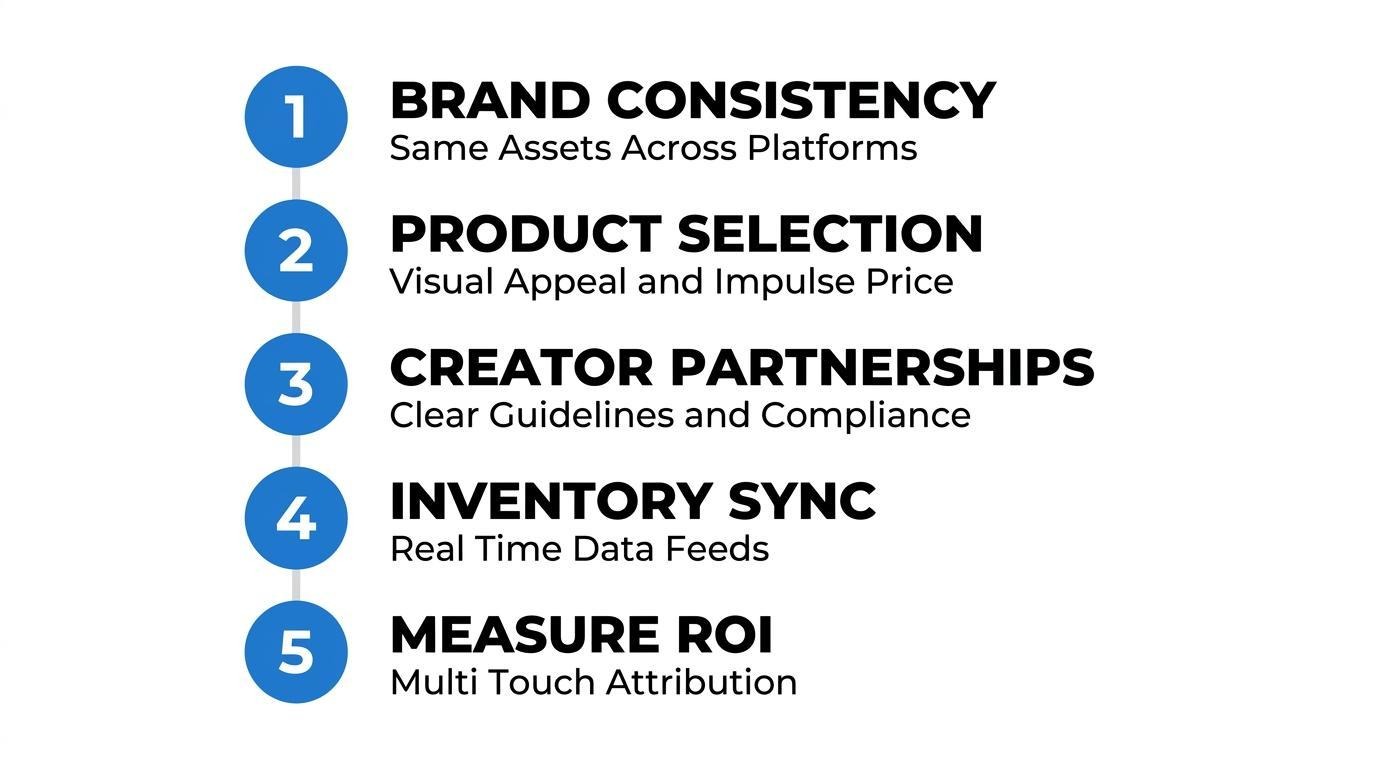
You build a consistent brand storefront across platforms by standardizing visual assets, product descriptions, and messaging before syndicating to each channel. Every platform, whether TikTok Shop, Instagram Shopping, or Facebook Shops, should display the same logos, color palette, tone, and pricing.
Start with a single source of truth for product content:
Brands that treat each social storefront as a separate project create fragmented experiences that erode buyer confidence.
You choose the right products to feature socially by prioritizing items with strong visual appeal, proven engagement signals, and impulse-friendly price points. Not every SKU in a catalog translates well to a social feed.
Products that perform best in social shopping share specific traits:
Hero products and new launches make strong candidates. Deep-catalog commodity items rarely justify the creative investment social channels demand.
You partner with creators without losing brand control by establishing clear content guidelines, approval workflows, and compliance requirements before any campaign launches. A detailed creative brief sets boundaries on messaging, visual standards, and mandatory disclosures while still allowing authentic creator voice.
Key safeguards include:
According to Productsup, without data synchronization, stock level changes can fail to reflect accurately in product inventory, causing channel compliance issues on marketplaces that track order defect rates. Connecting creators to live catalog data prevents promoting unavailable items.
You sync inventory and pricing across social channels by implementing real-time or near-real-time data feeds between your central product catalog and each platform's storefront. Manual or batch-based syncing creates dangerous gaps, especially during high-velocity sales periods.
According to Mortar, overselling is the biggest failure mode in multi-channel inventory sync, tracing back to batch or manual sync running too slowly for the inventory's actual velocity. Avoiding this requires:
For scaling brands running social storefronts alongside a DTC site, consolidating inventory management into a single system rather than stitching together separate tools for each channel eliminates most sync failures.
You measure social shopping ROI beyond last-click attribution by adopting multi-touch attribution models that credit each interaction a customer has before purchasing. Last-click attribution significantly undervalues social channels because discovery, engagement, and consideration often happen across multiple touchpoints before checkout.
More accurate measurement approaches include:
Social shopping's true value often shows up in metrics traditional attribution misses: higher lifetime value, stronger repeat purchase rates, and lower blended acquisition costs over time. Brands that evaluate social channels only through last-click lenses consistently underinvest in their highest-potential discovery channel.
With measurement frameworks in place, avoiding common mistakes becomes the next operational priority.
Common social shopping mistakes brands should avoid include unsynchronized product catalogs, neglected post-purchase engagement, and fragmented tech stacks. Each of these errors erodes trust and reduces lifetime value.
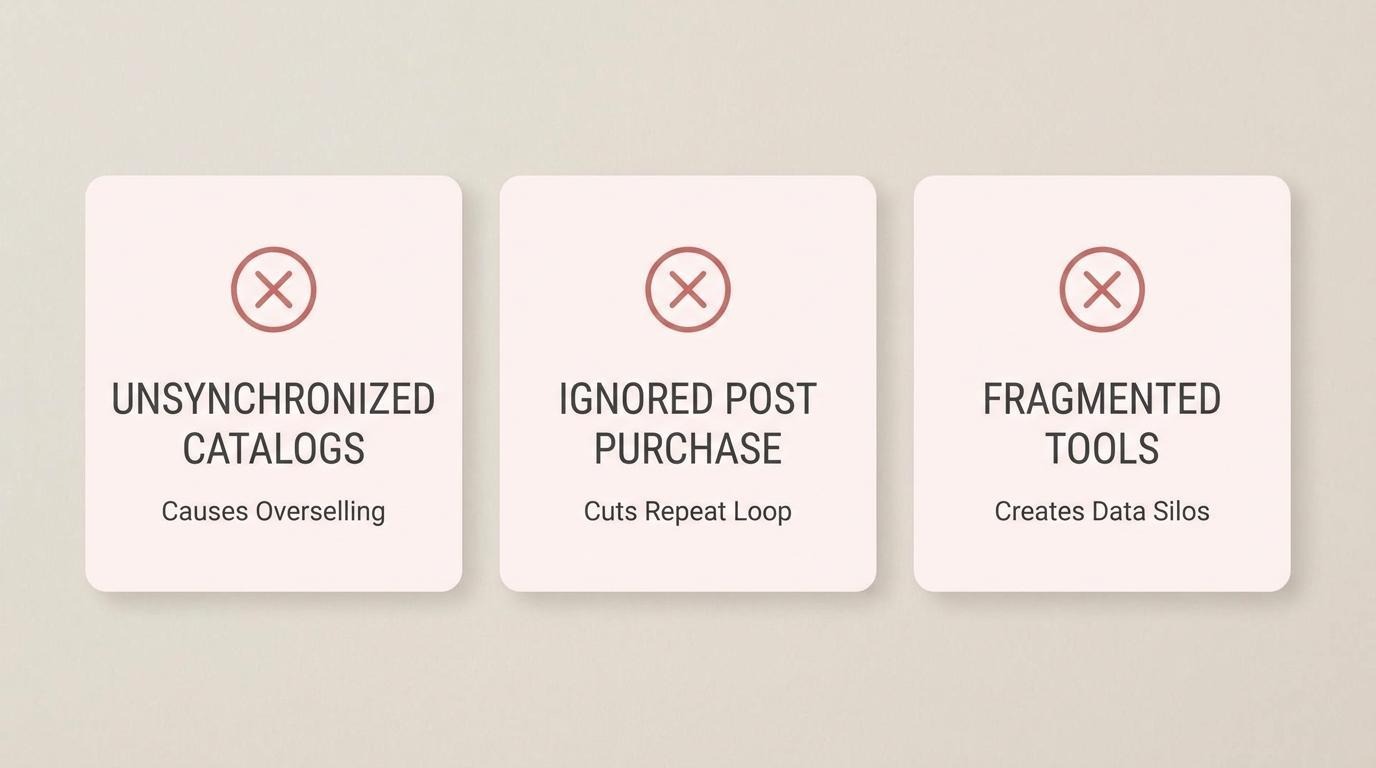
Product catalogs that are out of sync across channels cause overselling, incorrect pricing, and poor customer experiences. When inventory data on TikTok Shop, Instagram Shopping, or Facebook Shops lags behind the actual warehouse count, customers purchase items that are already sold out. According to Productsup, without data synchronization, stock level changes may fail to reflect accurately in product inventory, leading to order defect rate issues on marketplaces that strictly track fulfillment performance. These defects can trigger listing suspensions or reduced visibility. For brands selling across three or more social channels, real-time catalog sync is not optional; it is the operational baseline that prevents compounding errors at scale.
Ignoring post-purchase engagement hurts social shopping results because it cuts off the repeat-purchase loop that drives long-term profitability. Social shoppers who discover a brand through a live stream or shoppable post often make impulse-driven first purchases. Without follow-up touchpoints, such as order updates, review requests, loyalty offers, or replenishment reminders, that initial conversion becomes a one-time transaction. According to a 2026 projection by ATTN Agency, social commerce customers show 34% higher lifetime value compared to traditional acquisition channels, but only when brands actively nurture the relationship after the first sale. Failing to invest in post-purchase communication leaves that LTV potential unrealized and inflates acquisition costs over time.
Relying on too many disconnected tools fragments the customer journey by creating data silos between discovery, checkout, fulfillment, and retention. A shopper might engage with a brand on Instagram, purchase through a separate cart tool, receive shipping updates from a third platform, and never hear from the brand again because no system connects these interactions. According to ATTN Agency, 89% of DTC brands approach social commerce like traditional ecommerce with a social media wrapper, missing how customers actually discover and buy. Consolidating commerce, CRM, and marketing into fewer integrated systems keeps customer data unified and reduces the operational friction that causes drop-off between channels.
Social shopping fits into an omnichannel ecommerce strategy by extending the storefront into the social platforms where customers already browse, while feeding engagement and purchase data back into a unified commerce system. The key is treating social channels as integrated sales surfaces, not isolated marketing experiments.
For scaling DTC brands, social shopping becomes the connective layer between discovery and retention. Customers might find a product through a TikTok live stream, complete checkout via Instagram Shopping, then receive lifecycle follow-ups through email or SMS. Without a shared data layer tying those interactions together, each channel operates as a silo, and the omnichannel promise breaks down.
This is where operational complexity compounds quickly. Inventory must sync in real time across every social storefront and the primary ecommerce site. Pricing, promotions, and product details need consistency so customers encounter the same brand experience regardless of channel. According to a 2024 report by ATTN Agency, 89% of DTC brands approach social commerce like traditional ecommerce with a social media wrapper, completely missing the fundamental shift in how customers discover, evaluate, and purchase products. That gap between strategy and execution is precisely where omnichannel integration either succeeds or fragments.
The practical requirements include:
Social shopping is most effective when it is not bolted on as an afterthought. Brands that treat TikTok Shop, Instagram Shopping, and Facebook Shops as extensions of one commerce system, rather than separate experiments managed by the social media team, capture compounding value from each channel. The customer record stays intact, inventory stays accurate, and marketing automation can act on the full picture.
For brands operating at scale with multiple social storefronts, consolidating commerce, CRM, and marketing into fewer systems reduces the sync failures and data gaps that erode the omnichannel experience.
Scaling brands should consider data unification, inventory sync reliability, and stack consolidation when managing social shopping across multiple tools. The sections below cover how SHOPLINE approaches this challenge and the key takeaways for social shopping success.
SHOPLINE unifies social shopping data by housing commerce, CRM, marketing automation, and social channel management inside a single platform with a shared customer data layer. Rather than stitching together separate tools for TikTok Shop, Instagram Shopping, Facebook Shops, and a storefront, SHOPLINE resolves orders, customer profiles, and inventory from each channel into one system.
This matters because, as the article's earlier sections illustrate, disconnected tools fragment the customer journey and create inventory sync failures. When social channels, lifecycle marketing, and order management share the same backend, brands eliminate the reconciliation work that slows execution at scale. For DTC brands operating at $1M or above in revenue, reducing app stack complexity is often the difference between scaling smoothly and drowning in manual ops.
The key takeaways about social shopping benefits and best practices center on three principles: meet customers where they browse, keep your operations unified, and treat social channels as full commerce environments rather than awareness tools.
According to a 2026 forecast by ATTN Agency, 89% of DTC brands still approach social commerce like traditional ecommerce with a social wrapper, missing the fundamental shift in how customers discover and buy. Brands that recognize social shopping as its own discipline, not just a distribution channel, position themselves to capture a disproportionate share of a market projected to surpass $100 billion in the U.S. alone. Results may vary depending on implementation, industry, and scale.