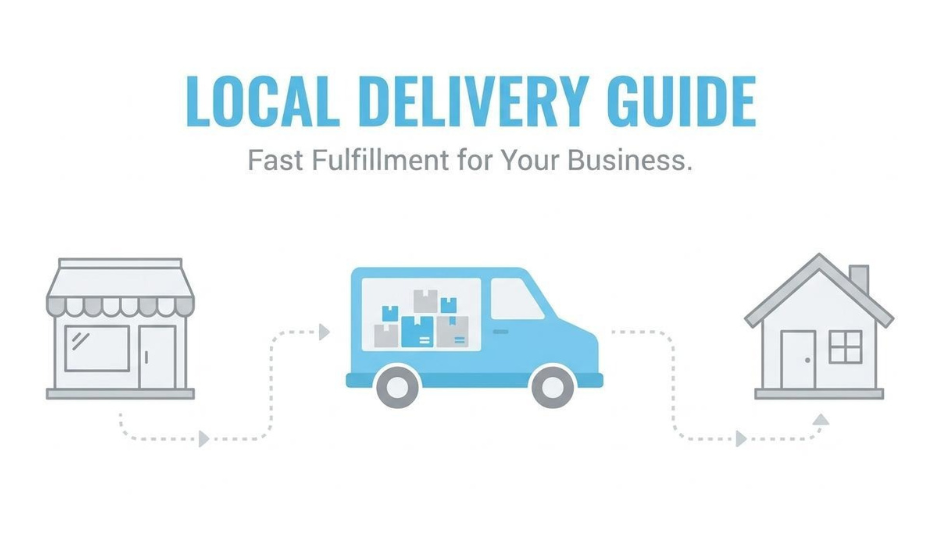
Local delivery is a fulfillment method where an online store delivers orders directly to customers within a defined geographic area, using its own drivers or local couriers instead of national shipping carriers. Products move from a nearby store or warehouse straight to the customer's door, often within hours or on the same day.
This guide covers the business case for local delivery, delivery models and zone planning, operational setup and pricing, daily management and performance tracking, and product-specific and multichannel considerations.
Local delivery strengthens customer experience by offering faster fulfillment windows, reduces shipping costs by eliminating carrier surcharges and dimensional weight pricing, and creates competitive separation through branded doorstep interactions that national retailers struggle to replicate at the neighborhood level.
Four primary delivery models exist for local fulfillment: in-house fleets, third-party courier services, crowdsourced platforms, and hybrid approaches that blend multiple methods. Each model differs in cost structure, scalability, and the degree of control you maintain over the customer experience.
Setting up local delivery requires defining zones by radius, ZIP code, or drive time; preparing vehicles, staff, and commercial insurance; then configuring delivery options, rates, and scheduling inside your ecommerce platform. Pricing strategies range from free delivery above a minimum order threshold to flat-rate and distance-based tiers.
Sustained performance depends on optimized routing, real-time customer notifications, documented protocols for failed deliveries, and weekly KPI tracking across cost per delivery, on-time rates, and first-attempt success. Product categories like food, apparel, furniture, and beauty each require distinct packaging, temperature control, and handling adjustments.
Unifying local delivery with online and in-store channels through a single system like SHOPLINE keeps inventory, orders, and customer data consistent as volume scales.
Local delivery in ecommerce is a fulfillment method where an online store delivers orders directly to customers within a defined geographic area, typically using its own drivers or local couriers instead of national shipping carriers. Unlike standard shipping that routes packages through distribution networks across multiple days, local delivery moves products from a nearby store, warehouse, or kitchen straight to the customer's door, often within hours or on the same day.
This model bridges the gap between the convenience of online ordering and the immediacy of in-store pickup. Businesses define a service area based on distance radius, ZIP codes, or drive time, then offer delivery windows at checkout. The approach works for any merchant with a physical inventory location, from restaurants and bakeries to apparel boutiques and home goods retailers.
Local delivery differs from other last-mile options in one important respect: the merchant controls the experience. With standard shipping, a third-party carrier owns the final handoff. With local delivery, the business decides how orders are packed, when they arrive, and how the driver interacts with the customer. That level of control makes it a valuable channel for brands building direct relationships in their community.
According to Roundtrip AI, the global last-mile delivery market was estimated at roughly $167.36 billion in 2025 and is projected to reach about $348.85 billion by 2033. That growth signals how central proximity-based fulfillment has become to modern ecommerce. The sections ahead cover why local delivery matters, which delivery models exist, and how to set up the entire operation from zone mapping to daily route management.
Your business should offer local delivery because it improves customer satisfaction, lowers fulfillment costs, and creates separation from competitors. The sections below cover each advantage in detail.
Local delivery improves customer experience by providing faster fulfillment windows and more predictable arrival times. Customers increasingly expect speed; according to McKinsey & Company, nearly 25 percent of consumers are willing to pay significant premiums for same-day or instant delivery, with younger consumers even more inclined at just over 30 percent.
On-time delivery (OTD) is one of the most important KPIs in last-mile fulfillment because late arrivals erode trust faster than almost any other service failure. When orders arrive within hours rather than days, customers associate the brand with reliability. That perception drives repeat purchases more effectively than discounts or loyalty points alone.
Local delivery reduces shipping costs by eliminating the carrier surcharges, dimensional weight pricing, and zone-based rate escalations that come with national shipping networks. Shorter routes mean lower fuel expenses, less packaging material, and fewer handoffs between sorting facilities.
Businesses that fulfill locally also avoid the cost spikes tied to peak-season carrier surcharges, which national carriers impose during holiday periods. For merchants selling bulky or heavy items, the savings are especially significant because parcel carriers price those shipments at a premium. Reinvesting even a portion of those savings into free or subsidized local delivery thresholds can reduce cart abandonment and increase average order value.
Local delivery gives you a competitive edge by offering a service tier that large national retailers struggle to replicate at the neighborhood level. Same-day and next-day windows create urgency that standard shipping cannot match, converting browsers who would otherwise comparison-shop.
Branded delivery also builds direct customer relationships. Unlike third-party fulfillment, your own drivers or local couriers represent your brand at the doorstep, reinforcing recognition and trust. For scaling brands, this direct touchpoint is often undervalued; it turns a transactional moment into a brand experience that no shipping label from a national carrier can replicate.
With the customer experience, cost, and competitive benefits established, the next step is choosing the right delivery model.
The types of local delivery models you can choose include in-house delivery, third-party courier services, crowdsourced platforms, and hybrid approaches. Each model differs in cost, control, and scalability.
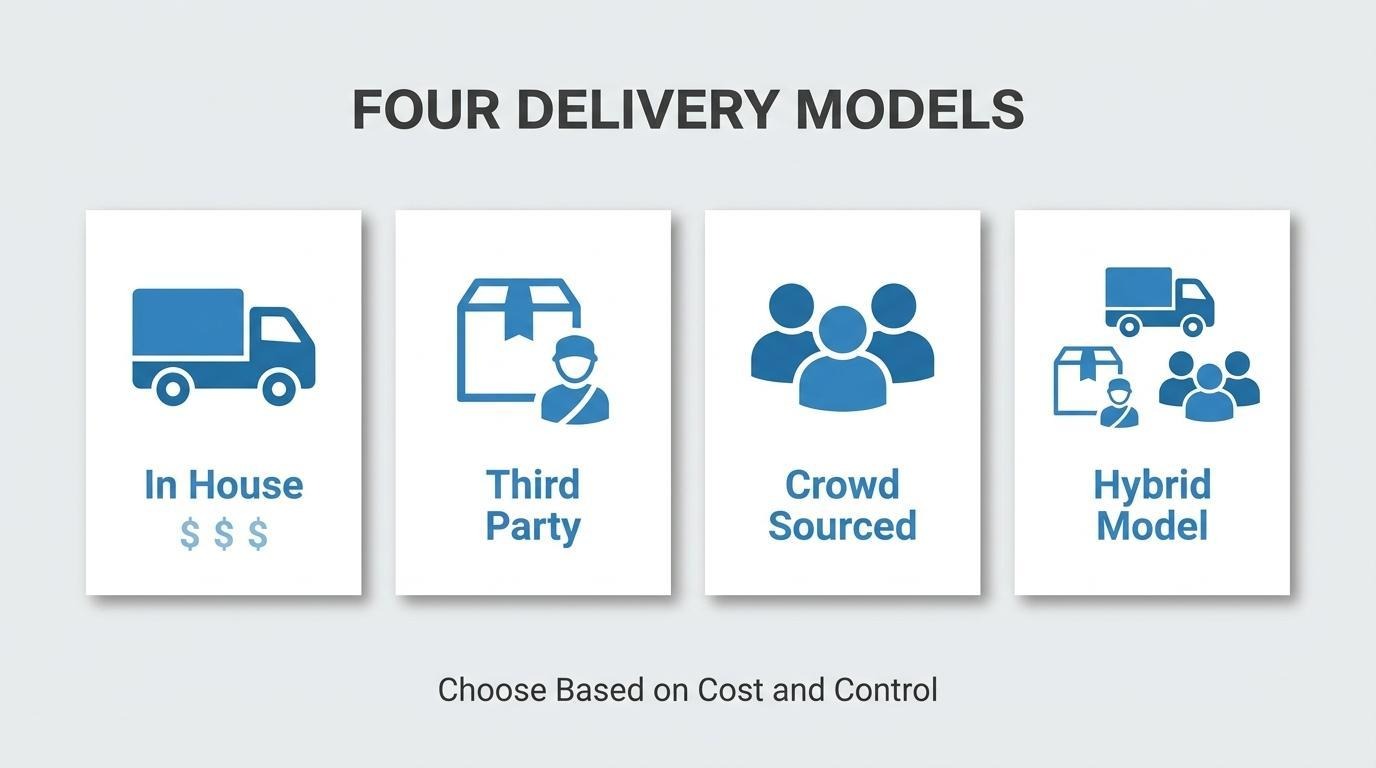
In-house delivery is a model where a business uses its own staff, vehicles, and logistics to fulfill local orders. This approach gives you full control over the customer experience, from branded packaging to delivery timing.
The trade-off is higher upfront investment. You manage driver wages, fuel, vehicle maintenance, and insurance directly. According to Intouch Insight, restaurant first-party apps charged an average delivery fee of just over $4, compared to under $2.02 on third-party platforms. That fee gap reflects the operational cost of running your own fleet. For brands prioritizing consistent service quality over the lowest per-delivery expense, in-house remains the strongest option.
Third-party local courier services are independent delivery companies that handle fulfillment on your behalf. You outsource the logistics, including drivers, vehicles, and route planning, while retaining control over order management and customer communication.
This model suits businesses that need reliable coverage without building a fleet. According to a 2025 Technavio report, the US courier and local delivery services market is projected to grow by USD 34.3 million at a 4.6% CAGR through 2030. That growth signals an expanding pool of professional courier options. The key risk is reduced visibility into the delivery experience once the order leaves your facility.
Crowdsourced delivery platforms are services that match your orders with independent drivers from a shared network, such as Roadie or DoorDash Drive. These platforms offer on-demand scalability without long-term staffing commitments.
Driver costs vary by platform. According to Gridwise, Roadie drivers earn a median of $12.70 per hour, while DoorDash drivers earn $11.26 per hour. Because drivers are independent contractors, you avoid payroll overhead but sacrifice direct control over delivery quality and branding. Crowdsourced models work well for handling demand spikes or testing local delivery before committing to a dedicated fleet.
Hybrid delivery models combine two or more approaches, such as using in-house drivers for high-priority or nearby orders while routing distant or overflow deliveries to third-party couriers. This structure balances cost efficiency with service control.
A common setup pairs a small internal team for core delivery zones with a crowdsourced platform for peak periods or extended-radius orders. The hybrid approach lets you protect brand experience where it matters most while keeping variable costs manageable during volume fluctuations. For most growing ecommerce operations, starting hybrid is more practical than committing fully to one model before understanding true demand patterns.
With your delivery model selected, the next step is defining the geographic zones where you will offer service.
You determine your local delivery zone by evaluating distance from your fulfillment location, geographic boundaries, and real-world drive times. The following subsections cover radius-based, ZIP code-based, and traffic-aware approaches.
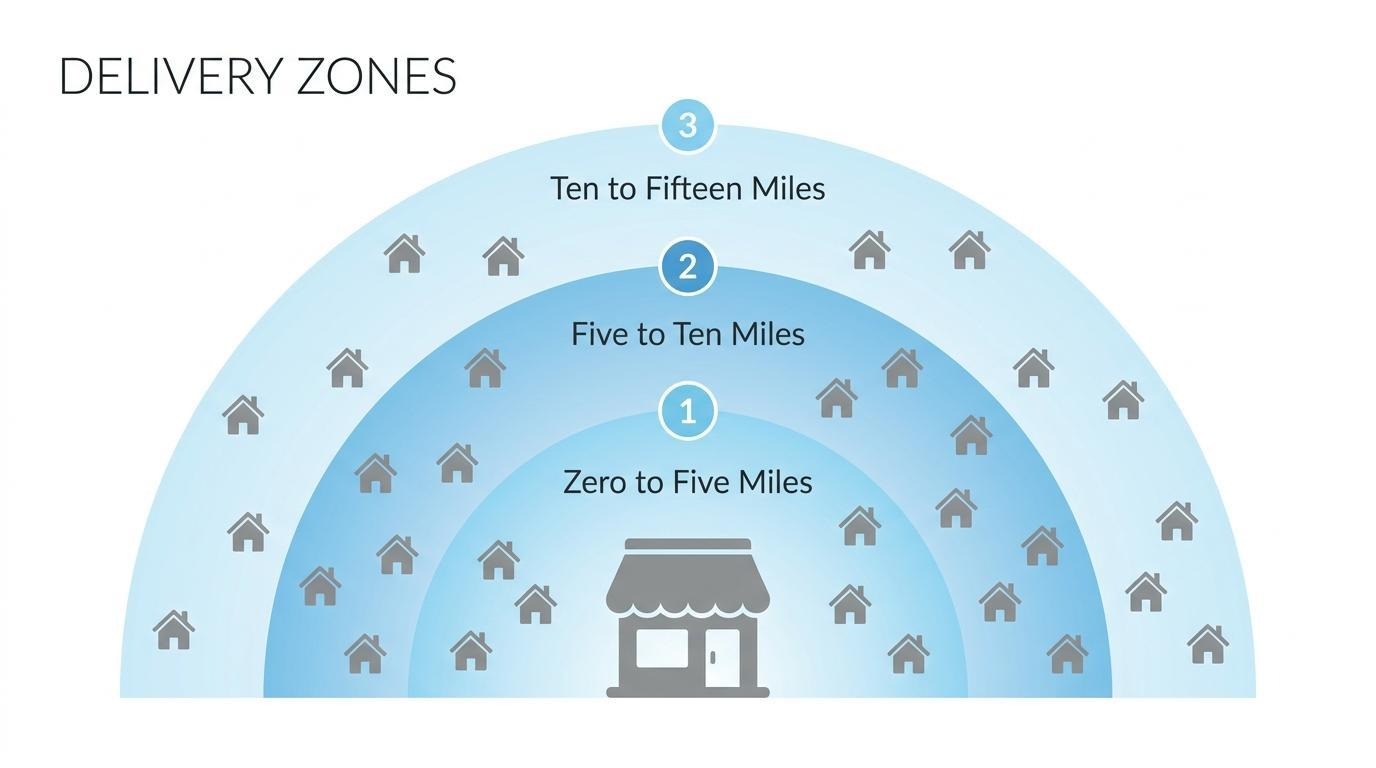
You set a delivery radius based on distance by drawing a fixed-mile circle around your store or warehouse and limiting orders to addresses within that boundary. Most small to mid-size businesses start with a 5- to 15-mile radius, then expand as demand and driver capacity grow.
The radius you choose directly affects per-order cost. According to SmartRoutes, urban deliveries typically cost around $10 per package, while rural deliveries can reach $50 due to lower population density and longer travel distances. Starting with a tighter urban radius keeps costs predictable while you gather enough order data to justify expansion. For scaling brands, reviewing cost-per-delivery by zone each month reveals exactly where the profitable boundary sits.
You define zones by ZIP code or neighborhood by grouping postal codes or named districts into delivery tiers, each with its own fee structure and time window. This method offers more precision than a simple radius because ZIP code boundaries follow real neighborhood lines rather than geometric circles.
A practical setup involves three steps:
ZIP code zoning also lets you exclude areas that are technically nearby but impractical to reach due to bridges, highways, or restricted-access neighborhoods.
You factor in drive time and traffic patterns by using route optimization tools that calculate actual travel time rather than straight-line distance. A location eight miles away may take 40 minutes during rush hour but only 15 minutes at midday, so static radius maps often underestimate real delivery costs.
According to Onfleet, an optimized delivery route can save 20% to 40% on fuel and drive time. Batch deliveries into time windows that avoid peak congestion, and use GPS-based routing software to sequence stops efficiently. Reviewing historical delivery data weekly helps you identify consistently slow corridors worth excluding from same-day promises.
With delivery zones clearly defined, the next step is preparing the vehicles, staff, and legal requirements you need before launch.
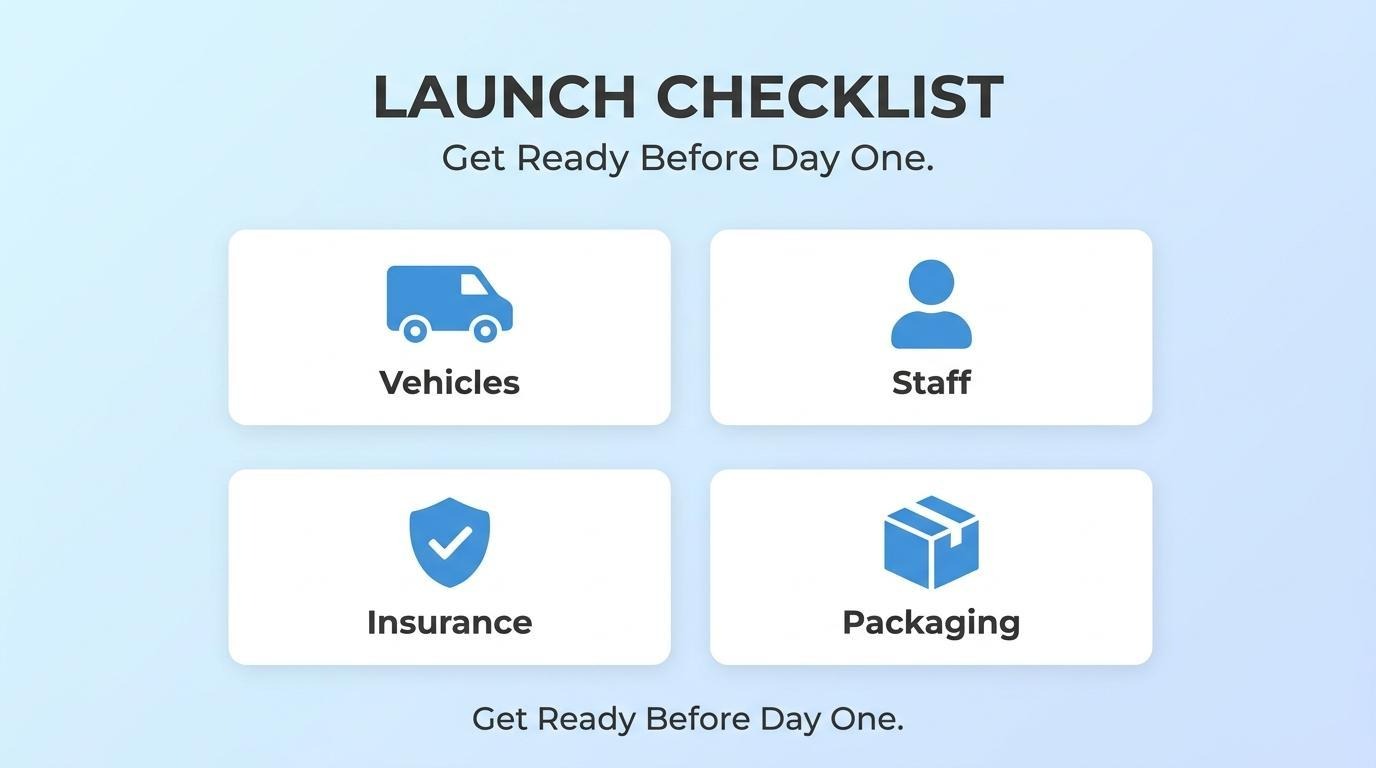
Before launching local delivery, you need the right vehicles, trained staff, proper insurance, and delivery-ready packaging. The sections below cover each prerequisite in detail.
The vehicles and equipment required for local delivery depend on your product size, volume, and delivery radius. Small, lightweight items like apparel or beauty products can be delivered using personal cars or compact vans. Bulky goods, such as furniture or large home décor, require cargo vans or box trucks with lift gates.
Essential equipment includes:
Matching vehicle capacity to your typical order profile avoids unnecessary fuel costs and keeps delivery times tight.
The staffing and driver requirements you should plan for include hiring reliable drivers, defining shift schedules, and establishing clear delivery protocols. Every driver needs a valid driver's license, a clean driving record, and familiarity with your delivery zone.
Key staffing considerations include:
Starting with one or two drivers and scaling based on order density is a practical approach for most small to mid-size brands entering local delivery.
The insurance and legal considerations that apply to local delivery include commercial auto coverage, liability protection, and proper worker classification. According to the Texas Department of Insurance, some personal auto policies may cover accidents during paid deliveries, but many businesses require drivers to carry commercial auto insurance because employers can be held liable for damages that occur during business driving.
Key areas to address:
Misclassifying drivers or skipping commercial coverage exposes your business to significant financial and legal risk.
The packaging adjustments local delivery requires differ from standard shipping because packages travel shorter distances but face more frequent handling, vehicle vibration, and temperature exposure. Oversized shipping boxes with excessive void fill are unnecessary; right-sized packaging reduces material costs and fits more orders per vehicle trip.
Practical adjustments include:
Well-designed local delivery packaging protects products, reinforces your brand at the doorstep, and lowers per-order material spend. With these prerequisites in place, the next step is configuring local delivery inside your ecommerce platform.
You set up local delivery on your ecommerce store by configuring delivery zones, setting rates, building a schedule, and enabling the option at checkout. Each step below walks through the process.
You configure delivery zones in your platform by defining the geographic boundaries where you will fulfill orders. Most ecommerce platforms let you create zones using two primary methods:
For stores serving both dense urban neighborhoods and outer suburbs, creating tiered zones (such as 0–5 miles, 5–10 miles, and 10–15 miles) gives you flexibility to adjust pricing and delivery windows by distance.
You set local delivery rates and minimum orders by choosing a fee structure that covers costs without discouraging purchases. Common approaches include:
Minimum order requirements also reduce the number of low-margin deliveries. Even a modest minimum, such as $25 to $35, filters out orders that cost more to deliver than they generate in profit.
You create a delivery schedule and time slots by defining which days and hours your team can fulfill local orders. Start by mapping your current staffing capacity and vehicle availability to specific delivery windows.
Scheduling discipline matters more than speed here. Consistently hitting a two-hour delivery window builds more trust than occasionally offering one-hour delivery and missing it.
You add local delivery as a checkout option by enabling it within your platform's shipping settings so eligible customers see it during purchase. The typical setup involves:
Testing the full flow before launch is essential. Place a test order from an address inside your zone and one outside to confirm the option appears and hides correctly. With checkout configured, the next step is deciding how to price delivery sustainably.
You should price local delivery based on your average order value, delivery costs, and competitive positioning. The three most common approaches are free delivery with a minimum order, flat-rate fees, and distance-based or zone-based pricing.
Yes, you should offer free local delivery with a minimum order when your margins support absorbing fulfillment costs above a specific cart threshold. A minimum order requirement increases average order value while offsetting driver wages, fuel, and packaging expenses.
Setting the right threshold matters. According to Digital Applied, the average direct-to-consumer free shipping threshold sits around $64, representing a 23% increase since 2019. Local delivery thresholds often run lower because fulfillment costs are reduced compared to traditional shipping.
Free delivery works especially well for businesses selling perishable goods, where speed justifies the cost absorption, and for stores competing in the fast-growing same-day delivery segment. For most merchants, placing the threshold 15% to 25% above average order value strikes the right balance between incentivizing larger carts and protecting margins.
You set flat-rate local delivery fees by calculating your average per-delivery cost and charging a single, predictable price regardless of order size or exact location within your zone. This model simplifies checkout and reduces cart abandonment.
To calculate your flat rate, total your monthly delivery expenses, including driver pay, fuel, vehicle wear, and packaging. Divide that by total monthly deliveries. Most small to midsize businesses land between $5 and $10 for a flat-rate local fee, though perishable or bulky items may justify higher charges. Flat-rate pricing works best when your delivery zone is compact and delivery distances stay relatively consistent. For merchants whose zones span wide geographic areas, a single flat rate risks undercharging distant orders while overcharging nearby customers.
Distance-based or zone-based pricing makes sense when your delivery area covers varying distances with significantly different fulfillment costs. Urban deliveries typically cost around $10 per package, while rural deliveries can reach $50 due to lower population density and longer travel distances, according to SmartRoutes.
Zone-based pricing assigns tiered fees by ZIP code groupings or radius bands. This approach lets you charge $5 for deliveries within 3 miles, $8 within 5 miles, and $12 beyond that, for example. Customers see fair, transparent pricing that reflects actual cost differences. This model particularly suits businesses covering suburban and semi-rural areas where a flat rate would either erode margins on distant deliveries or discourage nearby customers from ordering.
With pricing strategy established, the next step is managing daily delivery operations efficiently.
You manage local delivery operations day to day by optimizing routes, keeping customers informed with real-time updates, and having a clear process for failed deliveries. The following sections cover each of these operational pillars.
You optimize delivery routes by using route planning software that accounts for stop sequence, traffic patterns, and delivery windows. According to Onfleet, an optimized delivery route can save 20% to 40% on fuel and drive time.
Effective route optimization involves several key practices:
For businesses running more than a handful of daily deliveries, manual planning quickly becomes a bottleneck. Dedicated tools like OptimoRoute, Onfleet, or Circuit automate sequencing and reduce the guesswork that leads to late arrivals and wasted mileage.
You communicate delivery updates to customers through automated notifications at each fulfillment milestone. Proactive communication reduces "where is my order" inquiries and builds trust.
A reliable update sequence includes:
SMS tends to outperform email for time-sensitive delivery alerts because open rates are higher and messages arrive instantly. Most route optimization platforms include built-in customer notification features, which eliminates the need for a separate messaging tool. Giving customers a live tracking link further reduces anxiety and support tickets.
You handle failed or missed deliveries by establishing a documented reattempt policy before the first order ever goes out. Without a clear process, failed deliveries create customer frustration and erode margins through repeat trips.
A practical failed-delivery workflow covers these steps:
Every failed delivery adds cost through extra fuel, driver time, and potential product spoilage for perishable goods. Tracking your failed delivery rate as a weekly KPI helps identify recurring problems, whether that is unclear address formatting at checkout or delivery windows that consistently miss customers.
With daily operations running smoothly, tracking the right performance metrics reveals where to improve next.
Common local delivery mistakes to avoid include setting unclear delivery zones, underpricing delivery fees, skipping insurance coverage, neglecting real-time customer communication, and failing to plan for failed deliveries. Each of these errors increases costs, damages customer trust, or creates legal exposure.
Most of these mistakes share a root cause: launching delivery operations reactively instead of building standard procedures first. A documented playbook that covers zones, pricing, insurance, communication, and exception handling prevents the majority of operational failures before they reach the customer.
Tracking the right performance metrics reveals whether these mistakes are creeping into your operations over time.
You measure local delivery performance by tracking operational KPIs and collecting structured customer feedback. The sections below cover which metrics matter most and how buyer input drives continuous improvement.
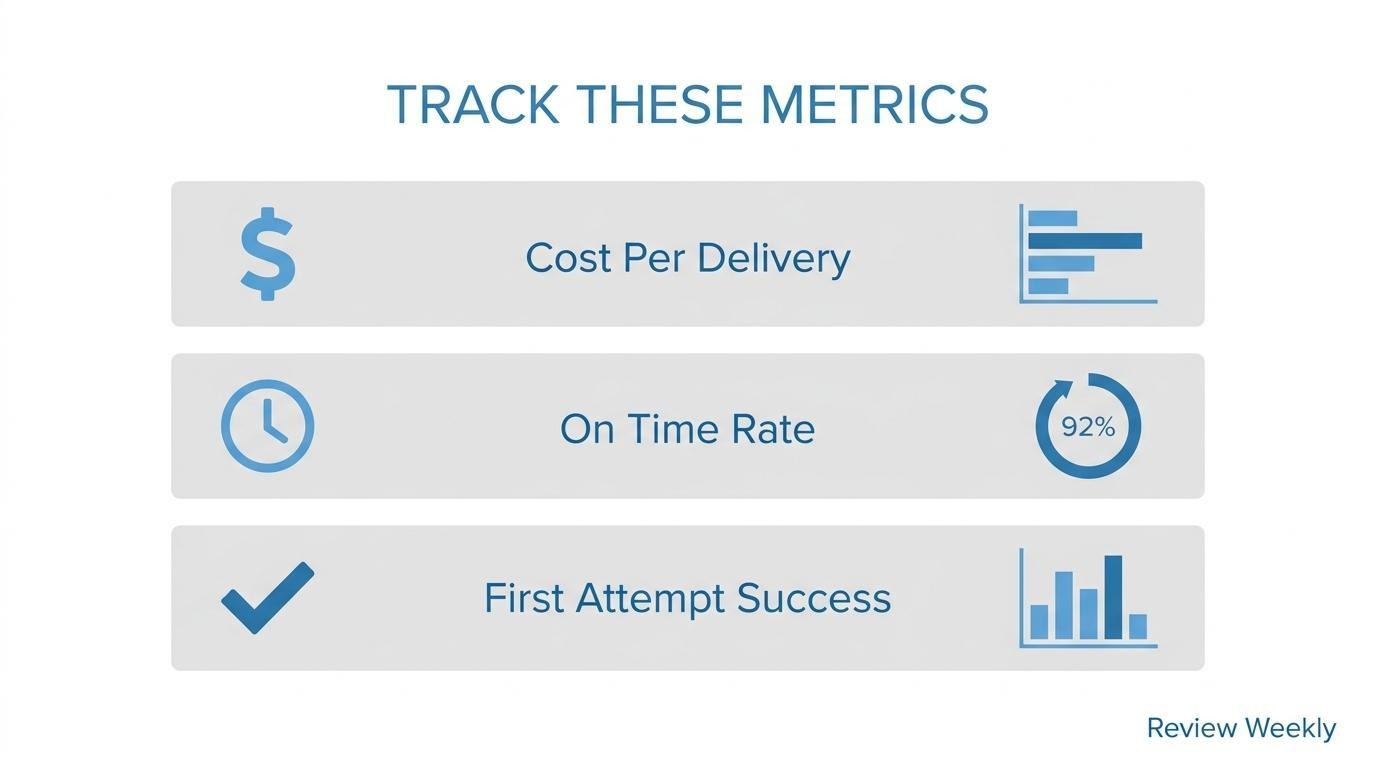
The KPIs you should track for local delivery include cost per delivery, on-time delivery rate, and first-attempt delivery success. According to Alsendo, the most important KPIs in last-mile delivery are cost per delivery for profitability and on-time delivery (OTD) for customer satisfaction. Beyond those two, several additional metrics round out a complete performance picture:
Reviewing these metrics weekly helps you spot patterns before they become costly operational problems.
You use customer feedback to improve delivery by collecting post-delivery ratings, identifying recurring complaints, and adjusting operations based on patterns. A short survey sent immediately after fulfillment captures the experience while details are still fresh.
Common feedback categories to monitor include:
When multiple customers flag the same issue, such as consistently late afternoon deliveries in a specific ZIP code, that signals a route planning or capacity gap. Feeding these insights back into driver briefings, route adjustments, and checkout messaging closes the loop between buyer experience and operational execution.
Understanding how delivery performs across product categories helps you apply these metrics with more precision.
Local delivery works for different product types by adapting packaging, temperature control, vehicle sizing, and handling protocols to each category's specific requirements. Below, we cover food and perishables, fashion and apparel, home goods and furniture, and beauty and personal care.
Local delivery for food and perishables works by maintaining strict temperature control from storage through final handoff. According to the U.S. Department of Agriculture (USDA), perishable foods must not be held between 40 and 140 °F (the "Danger Zone") for longer than two hours, as pathogenic bacteria can grow rapidly without affecting the taste, smell, or appearance of the food.
Meeting this standard requires insulated containers, ice packs or refrigerated vehicles, and tight delivery windows. Route planning matters more here than with any other product category, because every extra minute on the road increases spoilage risk. Businesses that batch perishable orders into short, concentrated delivery runs tend to maintain food safety while keeping costs manageable.
Local delivery for fashion and apparel works by prioritizing presentation, easy returns, and protection from weather. Garments arrive wrinkled or damaged far less often when packed in branded tissue, poly mailers, or rigid boxes rather than loose bags.
The bigger operational consideration is reverse logistics. Apparel has inherently higher return rates than most product categories, so building a return pickup option into local delivery routes reduces friction and encourages repeat orders. Drivers can collect returns on outbound runs, which saves a separate trip. For brands at scale, this return-loop efficiency often becomes the single biggest advantage local delivery holds over standard shipping.
Local delivery for home goods and furniture works by using appropriately sized vehicles, protective wrapping, and often a two-person delivery team. Blanket wraps, corner protectors, and strapping prevent surface damage during transit.
Larger items also require scheduling flexibility. Customers typically need to be home for bulky deliveries, so offering specific time windows (rather than full-day ranges) reduces failed delivery attempts. Threshold delivery versus room-of-choice placement should be clearly defined at checkout, since each level of service carries different labor and liability implications. For merchants selling anything above a certain weight or size, dedicating specific delivery days to furniture orders keeps route efficiency high.
Local delivery for beauty and personal care works by maintaining product integrity through temperature-sensitive handling and clean fulfillment environments. According to APS Fulfillment, good manufacturing practices (GMP) standards regarding cleaning, calibration, and staff hygiene are now mandatory expectations for fulfillment and warehousing of high-growth skincare and cosmetics.
Heat-sensitive products like serums, creams, and certain cosmetics can degrade if left in a hot delivery vehicle. Insulated packaging or scheduling deliveries outside peak afternoon heat addresses this risk. Leak-proof secondary packaging also protects multi-item orders. For beauty brands, the unboxing experience often doubles as a brand moment, so investing in presentation-quality packaging pays dividends in social sharing and customer loyalty.
With product-specific logistics covered, integrating these delivery workflows across your sales channels keeps fulfillment consistent as order volume grows.
You scale local delivery as order volume grows by expanding delivery zones incrementally, adopting route optimization technology, shifting toward hybrid delivery models, and tracking cost-per-delivery metrics to protect margins. The following strategies address the most critical scaling levers.
Expand zones in tiers. Start with your highest-density ZIP codes, then add adjacent areas only after consistent on-time performance is established in existing zones. Premature expansion spreads drivers thin and raises per-delivery costs.
Invest in route optimization software. According to Onfleet, an optimized delivery route can save 20% to 40% on fuel and drive time. Those savings compound significantly as daily order counts climb from dozens to hundreds.
Blend delivery models. A hybrid approach, combining in-house drivers for core zones with third-party couriers for overflow or fringe areas, keeps fixed labor costs manageable during demand spikes without sacrificing speed.
Batch orders into delivery windows. Consolidating orders into scheduled time slots rather than dispatching individually increases drop density per route. Higher drop density is the single most effective way to lower unit economics at scale.
Monitor KPIs relentlessly. Track these metrics as volume increases:
Upgrade packaging and fulfillment workflows. Higher volume exposes inefficiencies that were invisible at lower order counts. Standardized packing stations, pre-printed labels, and staging areas organized by delivery zone reduce pick-and-pack time per order.
Add fulfillment locations strategically. When a single origin point can no longer serve your zones efficiently, a second staging location closer to high-demand areas shortens average drive time and supports same-day windows.
For brands operating at scale across online and in-store channels, consolidating order and delivery data into one system prevents the operational fragmentation that typically undermines growth.
You manage local delivery alongside online and in-store channels by unifying order management, inventory, and customer data within a single system. The following sections cover how SHOPLINE handles this unification and the key takeaways for launching local delivery.
SHOPLINE unifies local delivery with POS and online orders by connecting all sales channels to one shared backend. Inventory updates in real time whether a sale happens at the register, through the online storefront, or via a local delivery order. Customer records stay consistent across channels, so purchase history and contact details are not siloed in separate tools.
This structure eliminates the reconciliation work that comes with running disconnected systems for each fulfillment method. Local delivery orders flow into the same dashboard as in-store pickups and shipped orders, which means staff can manage everything from a single screen. For brands operating at scale, having commerce, CRM, and POS resolve to one customer record removes a common pain point that multi-tool setups create.
The key takeaways about local delivery setup center on planning, compliance, and visibility.
The global last-mile delivery market is on pace to more than double by 2033. Businesses that build a reliable local delivery operation now position themselves to capture growing consumer demand for speed and convenience.