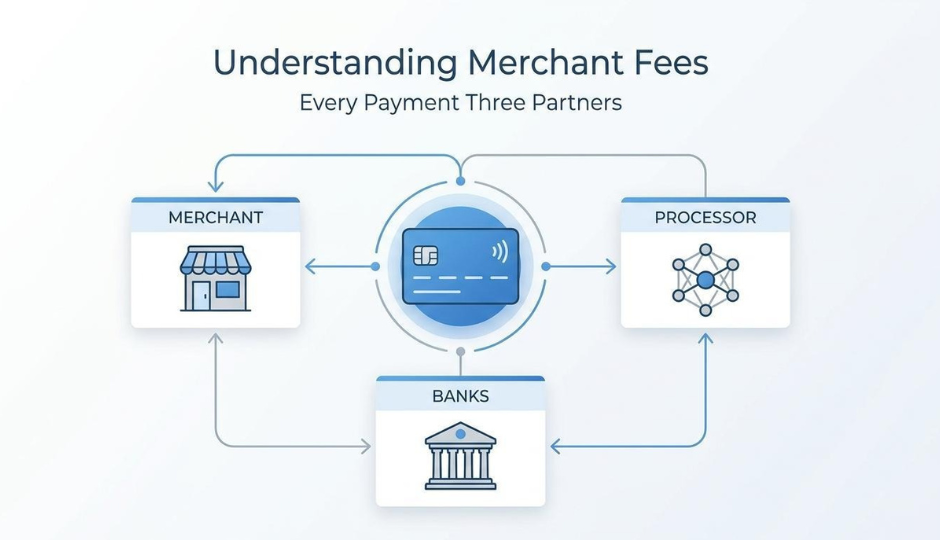
Merchant fees are the costs a business pays each time it accepts an electronic payment, covering the services provided by issuing banks, card networks, and payment processors that authorize, clear, and settle every transaction.
This guide covers the types of merchant fees and what each one funds, how pricing models calculate those fees differently, actual per-transaction costs across payment methods and sales channels, the entities and factors that determine your rates, and strategies for reducing fees and protecting margins at scale.
Every card transaction generates multiple fee components simultaneously. Interchange fees compensate issuing banks for credit risk and fraud exposure, assessment fees fund card network infrastructure, and processor markups pay for gateway access, encryption, and reporting tools. Beyond these core charges, merchants encounter PCI compliance fees, chargeback penalties, cross-border surcharges, batch processing costs, and contract-related charges like early termination fees.
How those components get bundled depends on the pricing model. Interchange-plus pricing separates each subfee into a transparent line item, while tiered pricing groups transactions into qualified, mid-qualified, and non-qualified categories that can obscure true costs. Flat-rate and subscription-based models offer simplicity or volume efficiency, respectively; each suits a different stage of business growth.
Actual costs per transaction vary by channel and card type. Credit cards typically run 1.5% to 3.5% per sale, regulated PIN debit falls below 1.0%, and online transactions carry higher rates than in-store payments due to elevated fraud risk. Card networks set their own interchange schedules, and factors like business category, chargeback history, and monthly volume all shift what a merchant ultimately pays.
At scale, even basis-point differences compound into significant annual expenses, making fee visibility, processor negotiation, and pricing model selection direct levers for protecting profit margins.
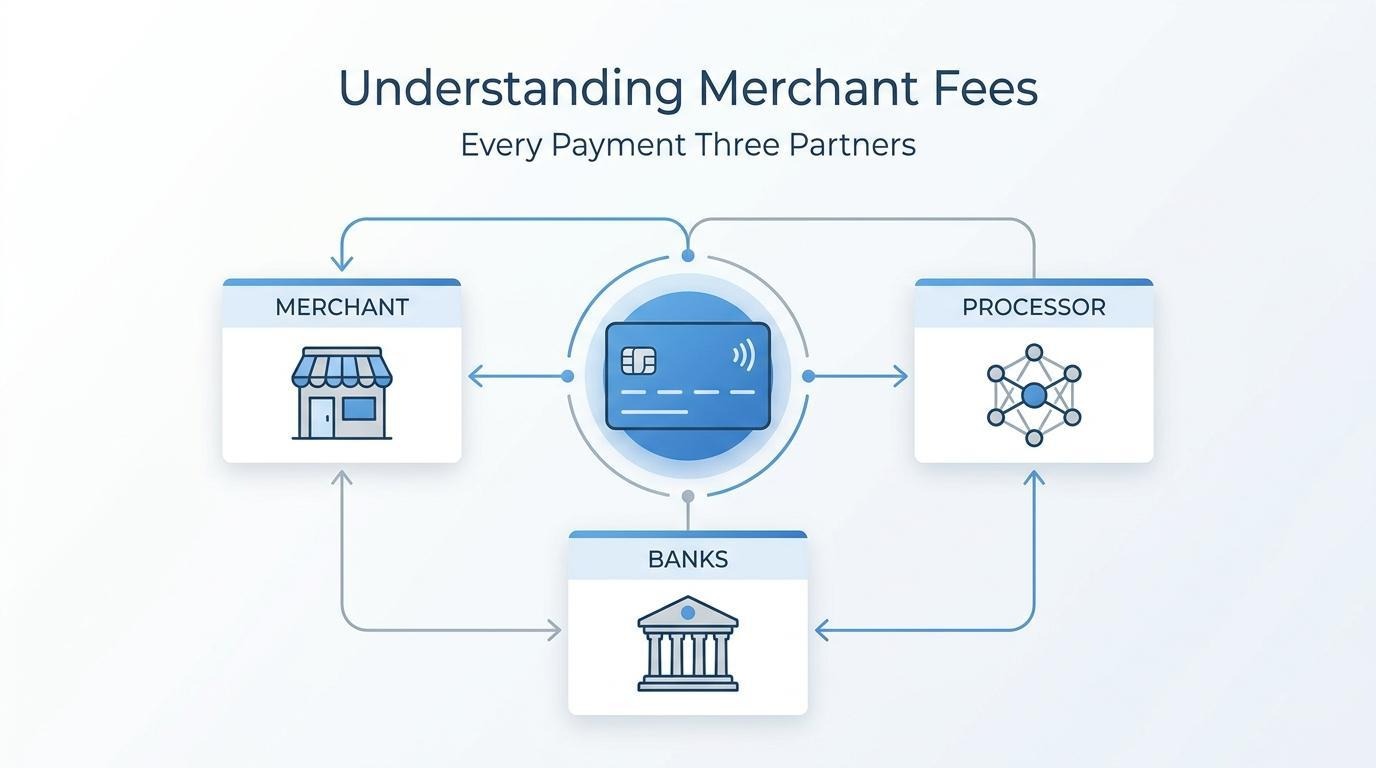
Merchant fees are the costs a business pays each time it accepts an electronic payment, such as a credit card, debit card, or digital wallet transaction. These fees compensate the banks, card networks, and payment processors involved in moving money from customer to merchant. The sections below cover who charges these fees, what each component includes, and why they exist.
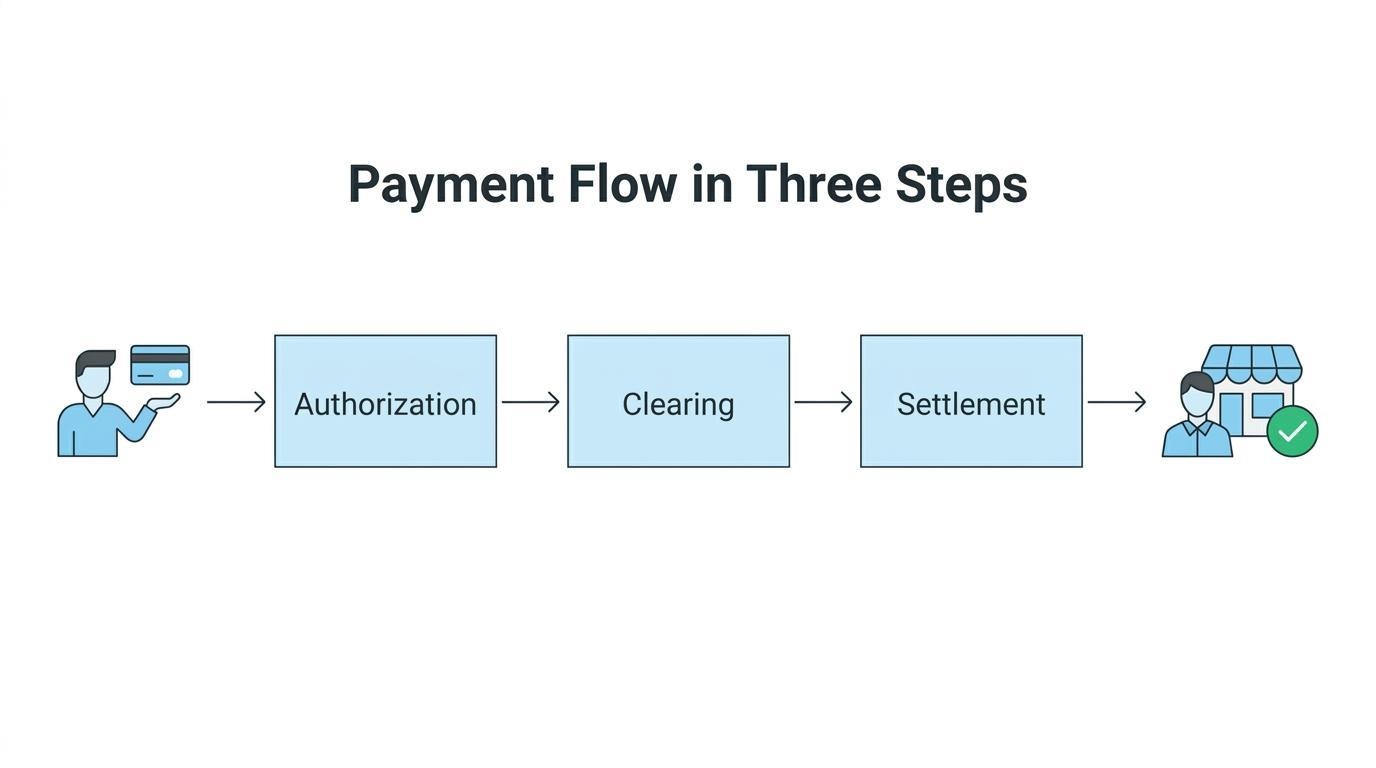
Merchants get charged processing fees because accepting card payments requires a chain of financial intermediaries, each providing a service that carries cost. These fees cover card network access, issuing bank risk, fraud prevention, and transaction routing.
Every time a customer taps, swipes, or enters a card number online, multiple parties work simultaneously to authorize, clear, and settle the payment. The issuing bank extends credit or verifies funds on behalf of the cardholder, assuming default and fraud risk in the process. Card networks like Visa and Mastercard maintain the infrastructure that routes transaction data between the merchant's acquiring bank and the cardholder's issuing bank. Payment processors handle the technical layer, encrypting sensitive data, communicating with networks, and depositing funds into the merchant's account.
Each of these participants charges a fee for its role:
Fraud protection alone represents a significant cost driver behind these fees. According to the Federal Reserve's 2023 interchange fee survey, fraud losses across all transactions for covered issuers reached 17.6 basis points, or $17.63 per $10,000 in transaction value. Merchants absorbed 49.9 percent of those losses, up from 38.3 percent in 2011. This rising fraud burden gets baked into the fee structures that processors and networks set.
Security compliance adds another layer. Merchants must meet PCI DSS standards to handle cardholder data, and processors embed those infrastructure costs into their pricing. Without these protections, data breaches would expose both merchants and customers to far greater financial harm.
From a practical standpoint, processing fees are the cost of participating in a cashless economy. For scaling brands, the real question is not whether these fees exist, but whether the payment infrastructure behind them delivers transparent pricing, consolidated reporting, and operational efficiency worth the cost.
Understanding exactly where each fee originates makes it possible to negotiate better rates and identify unnecessary charges, which the following sections break down by fee type.
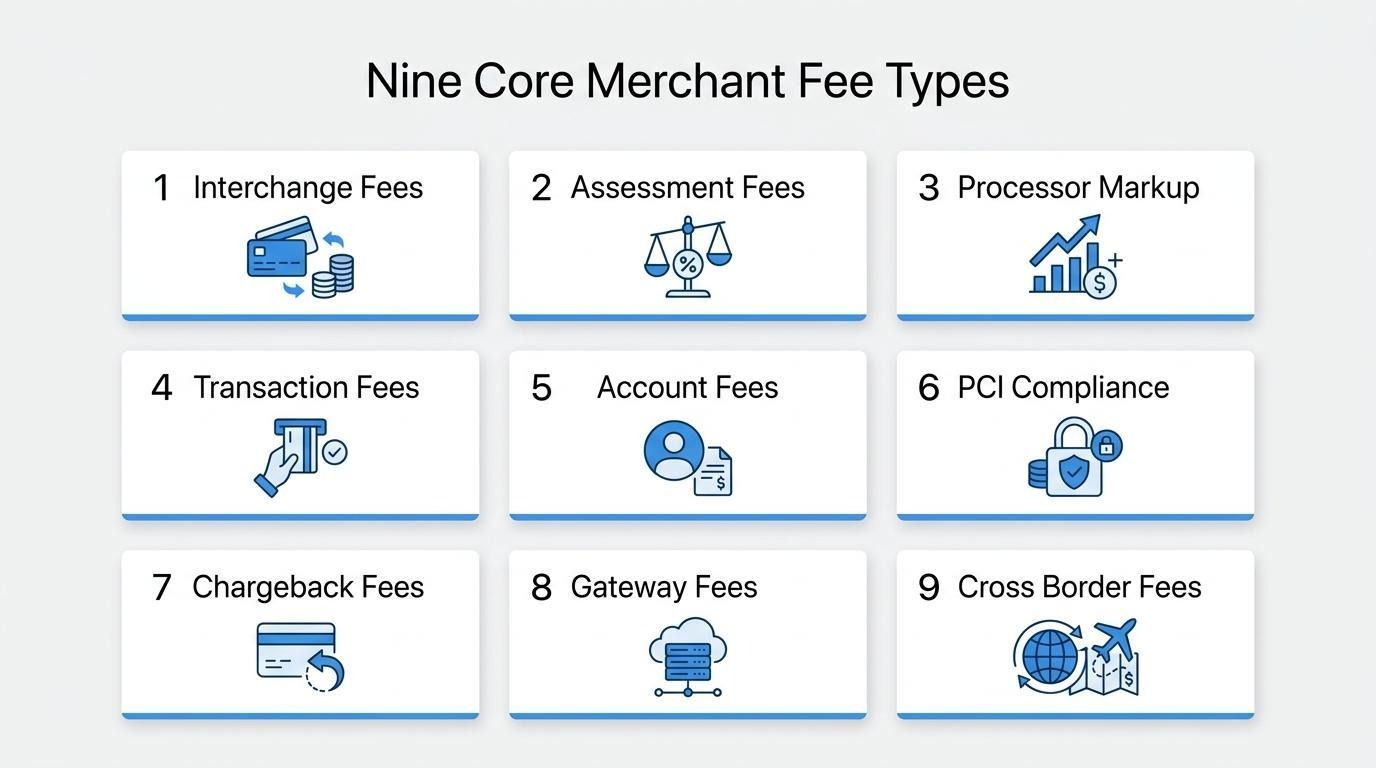
The types of merchant fees include interchange fees, assessment fees, processor markups, transaction fees, account fees, PCI compliance fees, chargeback fees, gateway fees, cross-border fees, batch processing fees, early termination fees, statement fees, and incidental charges.
Interchange fees are transfer fees paid by the acquiring bank to the issuing bank each time a card transaction occurs. According to Visa, interchange reimbursement fees serve as the mechanism for this transfer on every Visa card transaction. These fees vary based on card type, merchant category code, and how the transaction is processed (card-present versus card-not-present). Interchange typically represents the largest portion of total merchant processing costs. Because issuing banks set these rates through the card networks, merchants cannot negotiate them directly. Credit card interchange rates generally run higher than debit card rates, and rewards cards carry higher interchange than standard cards.
Assessment fees are charges that card networks such as Visa, Mastercard, American Express, and Discover collect on every transaction processed through their network. Unlike interchange fees paid to issuing banks, assessment fees go directly to the card network itself. These fees are calculated as a small percentage of total monthly transaction volume and apply uniformly to all merchants. Assessment rates are non-negotiable, published by each network, and updated periodically. While individually small per transaction, assessment fees accumulate significantly for high-volume merchants.
Payment processor markup fees are the charges a payment processor adds on top of interchange and assessment fees for handling transaction processing. As Stripe explains, interchange-plus pricing breaks every card transaction fee into three subfees: an interchange fee for the issuing bank, an assessment fee for the card network, and a processor markup.
Processor markups vary by pricing model:
The processor markup is the only component merchants can negotiate or comparison-shop.
Transaction fees are per-transaction charges applied each time a payment is processed, regardless of the transaction amount. Most processors charge a fixed cent amount (commonly $0.05 to $0.30) on top of any percentage-based fees. This fixed component disproportionately affects merchants with low average order values, since the per-transaction cost represents a larger share of small purchases. Some processors also distinguish between card-present and card-not-present transaction fees, with online and keyed-in payments typically incurring higher per-transaction rates due to elevated fraud risk.
Monthly or annual account fees are recurring charges processors collect for maintaining a merchant account. These fees cover account management, access to reporting dashboards, customer support, and platform infrastructure. Monthly fees typically range from $5 to $30 for basic accounts, while premium accounts with advanced analytics or dedicated support cost more. Some processors waive monthly fees in exchange for higher per-transaction rates. Annual fees, when charged separately, often appear as a single lump-sum deduction. Reviewing these recurring costs matters, since they add up independent of sales volume.
PCI compliance fees are charges related to meeting Payment Card Industry Data Security Standard requirements. Processors typically charge $79 to $120 annually to validate PCI compliance status. Non-compliance penalties, often labeled PCI non-compliance fees, range from $19.95 to $49.95 per month until the merchant completes the required self-assessment questionnaire or vulnerability scan. These fees fund the security infrastructure that protects cardholder data during and after transactions. Maintaining PCI compliance is not optional; failure to comply exposes businesses to both recurring penalty fees and significantly higher liability in the event of a data breach.
Chargeback fees are penalties charged to a merchant when a customer disputes a transaction and the card issuer reverses the payment. Each chargeback typically costs between $20 and $100, depending on the processor. Beyond the fee itself, the merchant loses the original transaction amount and the product or service already delivered. High chargeback ratios can trigger placement in card network monitoring programs, which impose additional fines and increased processing rates. Merchants with excessive dispute rates risk account termination. Investing in fraud prevention tools, clear billing descriptors, and responsive customer service helps reduce chargeback frequency.
Gateway fees are charges for using a payment gateway, which securely transmits transaction data between the merchant's website or point-of-sale system and the payment processor. Gateways typically charge a monthly fee ($10 to $25) plus a small per-transaction fee. Some processors bundle gateway access into their standard pricing, while others bill it separately. For e-commerce merchants, a payment gateway is essential since it encrypts card data and routes authorization requests. Merchants operating exclusively through in-store terminals may not need a separate gateway, though many modern POS systems integrate gateway functionality natively.
Cross-border or international transaction fees are surcharges applied when a transaction involves a card issued outside the merchant's country. These fees typically add 1% to 2% on top of standard processing rates and cover currency conversion costs and the additional risk associated with international payments. As cross-border e-commerce continues expanding, these fees become a meaningful cost factor for merchants selling globally. Some processors also charge a separate currency conversion fee in addition to the cross-border surcharge. Merchants targeting international customers should compare cross-border fee structures across processors to protect margins.
Batch processing fees are small charges applied each time a merchant submits a group of authorized transactions to the processor for settlement. Most merchants "batch out" daily, sending all of the day's transactions at once. Fees typically range from $0.10 to $0.30 per batch. According to the Nilson Report, U.S. merchants paid a record $187.20 billion in processing fees in 2024, underscoring how even minor per-batch charges contribute to overall processing costs at scale. While individually negligible, batch fees are a fixed daily cost regardless of transaction volume, making them proportionally more significant for low-volume merchants.
Early termination fees are penalties charged when a merchant cancels a processing contract before the agreed term ends. These fees range from $200 to $500 or more, depending on the contract. Some processors calculate the penalty as a flat fee, while others charge liquidated damages based on remaining months multiplied by estimated monthly processing revenue. Not all processors impose early termination fees; month-to-month agreements typically avoid them entirely. Before signing any processing contract, merchants should review cancellation terms carefully. Choosing a processor with no long-term commitment eliminates this risk.
Statement fees are monthly charges for generating and delivering transaction statements. These fees typically range from $5 to $15 per month. Many processors now provide digital statements through online portals at no additional cost, though some still charge for paper delivery. Statement fees may seem trivial individually, yet they represent a recurring fixed expense that persists regardless of sales activity. When evaluating processor pricing, merchants should confirm whether statement fees are included in the monthly account fee or billed separately.
Incidental and miscellaneous fees are less predictable charges that appear under various circumstances during the merchant-processor relationship. Common examples include:
These fees rarely appear on rate comparison sheets, which makes reviewing the full fee schedule in any processor agreement essential before signing.
Understanding each fee type gives merchants the foundation to evaluate processor pricing models accurately.
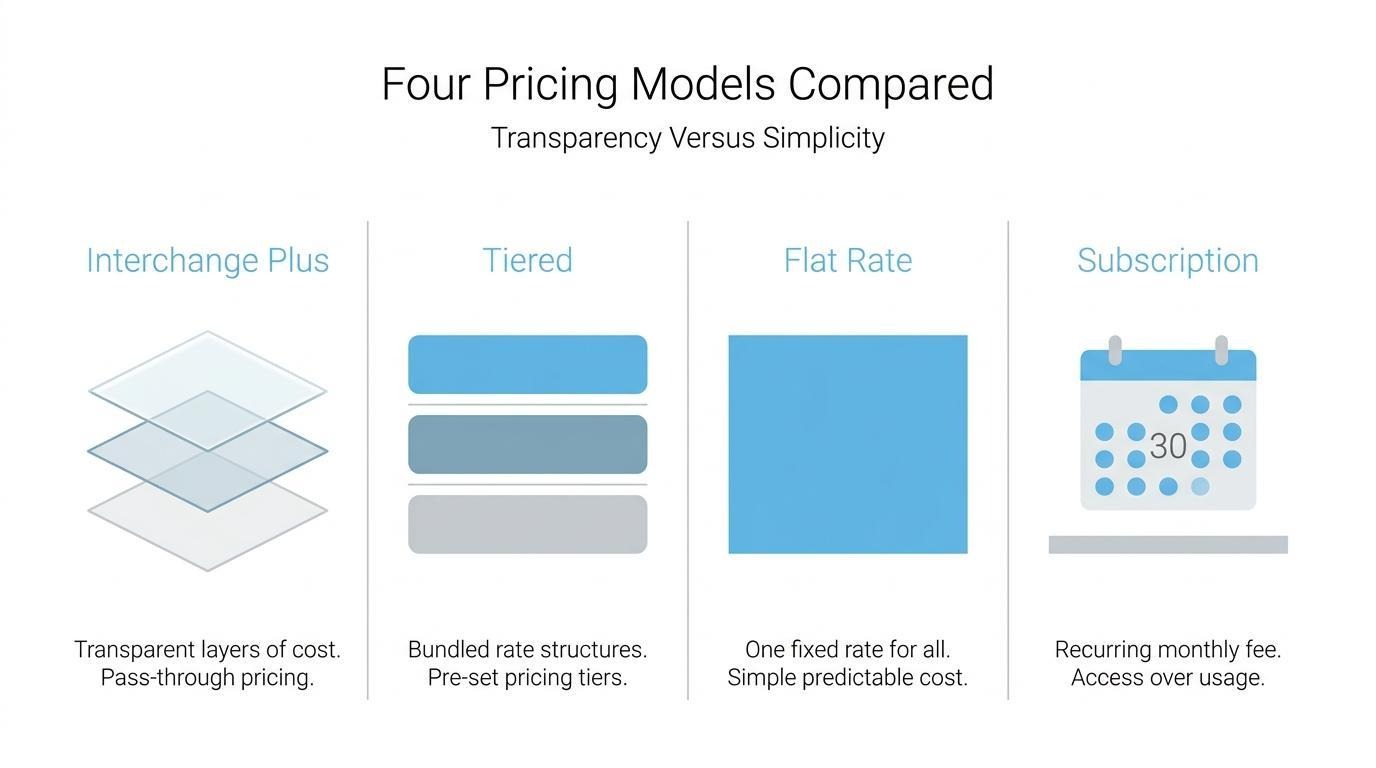
Merchant fees are calculated using one of four common pricing models: interchange-plus, tiered, flat-rate, or subscription-based. Each structures the relationship between interchange costs, network assessments, and processor markups differently.
Interchange-plus pricing works by separating each transaction fee into three transparent subfees: an interchange fee paid to the issuing bank, an assessment fee paid to the card network, and a fixed processor markup. According to Stripe, this model makes every card transaction fee a sum of these three distinct components, giving merchants clear visibility into where each dollar goes.
Because the interchange rate varies by card type and transaction method, total costs fluctuate from one sale to the next. The processor's markup, however, stays constant. This transparency makes interchange-plus particularly valuable for high-volume merchants who want to verify they are not overpaying on any single transaction category.
Tiered pricing works by sorting transactions into three categories: qualified, mid-qualified, and non-qualified. Each tier carries a different rate, with qualified transactions receiving the lowest fees. According to NMI, many transactions fall into the mid-qualified or non-qualified tiers, which carry higher rates.
The processor determines which tier a transaction lands in based on factors such as card type, whether the card was present, and how the transaction was processed. This bundling obscures the actual interchange cost behind each sale, making it difficult to audit what you are truly paying. For scaling brands processing diverse card types across multiple channels, tiered pricing often results in unpredictable monthly statements.
Flat-rate pricing works by charging merchants a single fixed percentage for every transaction, regardless of card type or processing method. This simplicity eliminates the need to track interchange categories or tier classifications.
The trade-off is cost efficiency. When a transaction's actual interchange rate falls well below the flat rate, the processor retains a wider margin. Flat-rate models suit businesses with lower volume or those that prioritize predictability over optimization. As transaction volume grows, however, the cumulative overpayment on lower-interchange transactions becomes significant enough to warrant evaluating more granular models.
Subscription-based pricing works by charging merchants a fixed monthly fee for access to the payment processor, then passing interchange and assessment fees through at cost with zero or minimal markup per transaction. The monthly subscription replaces the per-transaction processor margin found in other models.
This structure benefits merchants with high transaction volume because the effective per-transaction cost decreases as sales increase. The fixed monthly fee remains constant whether you process 500 or 50,000 transactions. For brands scaling past significant monthly volume thresholds, subscription pricing often delivers the lowest total processing cost among all four models.
Understanding how each model calculates fees makes it easier to estimate what you will actually pay per transaction.
Merchant fees per transaction vary by payment method, sales channel, and card type. Credit cards carry the highest per-transaction costs, while debit cards and in-store POS transactions tend to be lower.
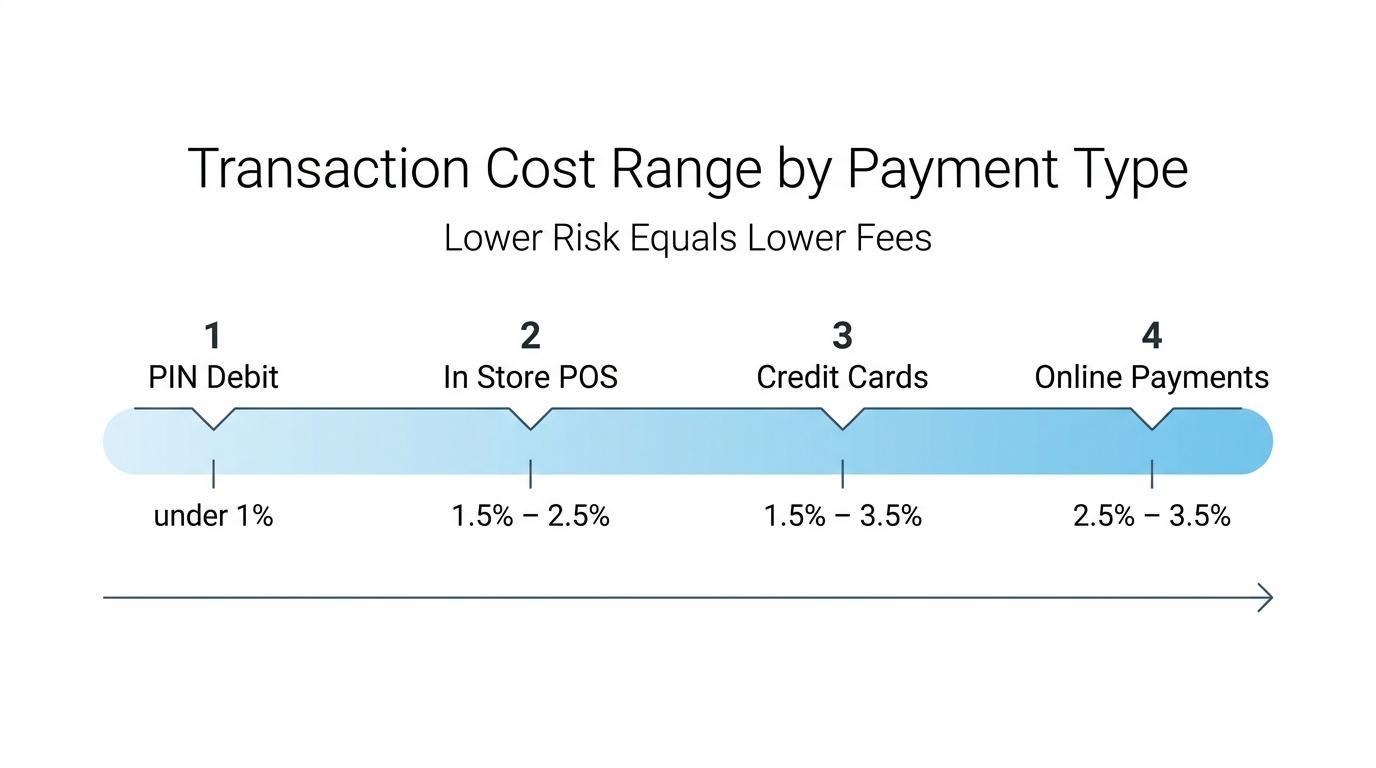
Credit card merchant fees typically cost between 1.5% and 3.5% of each transaction's value, depending on the card network, card type, and pricing model. According to The Nilson Report, U.S. merchants paid a record $187.20 billion in processing fees in 2024, with a weighted average of $1.57 per every $100 in card payments accepted. That weighted average has fluctuated between 1.45% and 1.57% over the last decade.
Premium rewards cards and corporate cards sit at the higher end of this range, while basic consumer cards tend to fall closer to 1.5%. With flat-rate pricing, merchants pay a single fixed percentage regardless of card type or processing method, which simplifies cost forecasting but may not yield the lowest effective rate at higher volumes. For most scaling merchants, understanding which card types dominate their transaction mix is the first step toward negotiating better rates.
Debit card merchant fees cost significantly less than credit card fees, generally ranging from 0.5% to 1.0% per transaction for regulated debit. PIN debit transactions processed through single-message networks carry the lowest interchange rates because they involve fewer intermediaries and lower fraud risk.
According to the Board of Governors of the Federal Reserve System, U.S. payment card networks processed 100.7 billion debit and general-use prepaid card transactions valued at $4.7 trillion in 2023. The sheer volume of debit transactions gives merchants strong incentive to encourage debit use at checkout. Signature debit, processed over dual-message networks, typically costs more than PIN debit but still remains below credit card interchange levels. For businesses with high transaction counts and moderate average order values, steering customers toward debit can meaningfully reduce total processing costs.
Online payment merchant fees cost more than in-store transactions, typically ranging from 2.5% to 3.5% plus a fixed per-transaction fee. Card-not-present transactions carry higher interchange rates because they present greater fraud risk to issuing banks.
That elevated risk has measurable consequences. According to the Board of Governors of the Federal Reserve System, merchants absorbed 49.9% of losses from fraudulent transactions in 2023, up from 38.3% in 2011. This rising fraud liability is one reason online processing fees remain higher; issuers and networks price that risk into interchange schedules. Gateway fees, 3D Secure authentication charges, and currency conversion surcharges can further increase the effective cost per online transaction. Merchants selling primarily through ecommerce should factor fraud prevention tools into their total cost of acceptance, not just the headline processing rate.
In-store POS merchant fees cost less than online fees, generally falling between 1.5% and 2.5% per transaction for credit cards and below 1.0% for regulated PIN debit. Card-present transactions benefit from lower interchange rates because the physical card and cardholder verification reduce fraud risk substantially.
Chip-and-PIN (EMV) transactions and contactless tap-to-pay carry the lowest in-store rates since both authentication methods shift fraud liability away from the issuer. Swiped magnetic stripe transactions, while declining in use, still carry slightly higher rates due to their weaker security profile. Terminal rental or purchase costs, PCI compliance fees, and batch processing fees also contribute to overall in-store processing expenses. For high-volume brick-and-mortar operations, even small differences in per-transaction rates compound quickly, making terminal type and payment method mix important cost levers.
Understanding transaction costs across channels sets the stage for identifying who actually determines these rates.
Merchant fee rates are set by multiple entities across the payment chain, not a single authority. Card networks, issuing banks, payment processors, and government regulators each control different fee components.
Card networks like Visa and Mastercard publish interchange fee schedules that apply to every transaction routed through their systems. Issuing banks receive these interchange fees, while the networks themselves collect separate assessment fees. Payment processors then add their own markup on top of these base costs, and the markup varies by pricing model, contract terms, and the merchant's risk profile.
Government regulators also play a direct role. According to the Board of Governors of the Federal Reserve System, Regulation II caps debit interchange fees for covered issuers at $0.21 plus 0.05 percent of the transaction value, plus a $0.01 fraud-prevention adjustment. Credit card interchange, by contrast, remains unregulated at the federal level, which is why credit transactions carry higher fees than debit.
For merchants processing at scale, understanding which entity controls each fee layer is essential. Interchange and assessment fees are non-negotiable, set by networks and enforced uniformly. The processor markup is the one component where negotiation, volume leverage, and platform choice make a meaningful difference.
Understanding this fee-setting hierarchy clarifies why rates vary so widely across card types and networks.
Merchant fees differ by card network because Visa, Mastercard, American Express, and Discover each set their own interchange and assessment rate structures. Below, each network's typical fee ranges are broken down.
Visa's typical merchant fees range from approximately 1.4% to 2.5% of the transaction value, depending on card type and merchant category. Visa uses interchange reimbursement fees as transfer fees between acquiring banks and issuing banks for each transaction, according to Visa's published rate documentation. Consumer credit cards sit at the higher end of that range, while regulated debit cards fall well below it. Assessment fees, which Visa charges separately, add a smaller percentage on top of interchange. Because Visa publishes hundreds of interchange categories, the actual rate a merchant pays varies by industry code, transaction method, and whether the card is present or not.
Mastercard's typical merchant fees fall in a similar range to Visa, generally between 1.4% and 2.5% for credit transactions. Mastercard structures its interchange schedule by merchant category, card product tier, and transaction type. Premium rewards cards carry higher interchange rates than standard cards, which means merchants selling high-ticket items to rewards-card holders absorb more per sale. Mastercard's assessment fees are assessed as a small percentage on gross transaction volume. For most U.S. merchants processing standard consumer credit, the all-in cost closely mirrors Visa's rates. However, specific rate categories can diverge depending on the card product and acceptance environment.
American Express's typical merchant fees are higher than those of Visa and Mastercard, generally ranging from 2.5% to 3.5% per transaction. This premium reflects American Express's closed-loop network model, where it often acts as both the card network and the issuing bank. Merchants pay a single discount rate rather than separate interchange and assessment components. The higher cost is one reason some smaller merchants historically chose not to accept American Express. For businesses whose customers frequently carry Amex cards, declining to accept the network means losing sales, so the fee becomes a cost-of-revenue calculation rather than a simple expense line.
Discover's typical merchant fees range from approximately 1.5% to 2.5%, placing the network between Visa/Mastercard and American Express in overall cost. Like American Express, Discover operates a closed-loop network, but its interchange rates tend to be more competitive. Discover holds a smaller share of U.S. card volume compared to Visa and Mastercard, which means fewer transactions for most merchants. Assessment fees from Discover are structured similarly to the larger networks. For merchants evaluating whether to accept all four major networks, Discover's rates rarely present a significant cost obstacle relative to its transaction volume.
Understanding each network's fee structure helps merchants forecast processing costs more accurately, which matters when evaluating factors that push those fees higher.
The factors that influence how high your merchant fees are include your business type, transaction method, card brand accepted, sales volume, chargeback history, and pricing model. Each factor shifts what processors, networks, and issuing banks charge per transaction.
Business industry and risk classification determine your baseline rates. Processors assign a merchant category code (MCC) to every business, and industries with higher fraud or chargeback exposure, such as travel, digital goods, or subscription services, receive elevated interchange categories. A low-risk retailer selling physical goods in store typically qualifies for lower interchange tiers than a high-risk online merchant.
Transaction method directly affects fee levels. Card-present transactions processed through a chip reader or tap-to-pay terminal carry lower interchange rates than card-not-present transactions entered online or by phone. The reduced fraud risk of in-person payments is the primary reason networks price them lower.
Card type and brand create significant rate variation. Rewards credit cards and premium cards carry higher interchange fees than standard debit cards because issuers fund cardholder perks through those fees. American Express historically charges higher merchant discount rates than Visa or Mastercard, though gaps have narrowed.
Monthly sales volume and average ticket size influence your negotiating position. Higher-volume merchants can often secure lower processor markups, while very small average transactions may carry disproportionate per-transaction fixed fees that erode margins.
Chargeback ratio impacts both current costs and future pricing. According to a 2023 Federal Reserve report, merchants absorbed 49.9 percent of losses from fraudulent transactions reported by covered issuers, up from 38.3 percent in 2011. A rising chargeback rate triggers penalty fees and can push a business into a higher-risk pricing tier with its processor.
Pricing model selection shapes overall fee transparency and cost. Interchange-plus pricing passes through actual interchange rates with a fixed markup, giving merchants visibility into each component. Flat-rate models simplify billing but may cost more on lower-interchange transactions. Tiered pricing bundles transactions into qualified, mid-qualified, and non-qualified categories, often routing charges into higher tiers.
For merchants processing across multiple channels, these factors compound. A brand selling online, in store, and through subscriptions faces different interchange categories, risk profiles, and per-channel fees simultaneously. Understanding which levers you control, such as reducing chargebacks, optimizing transaction methods, and negotiating processor terms, is the most direct path to lowering your effective rate.
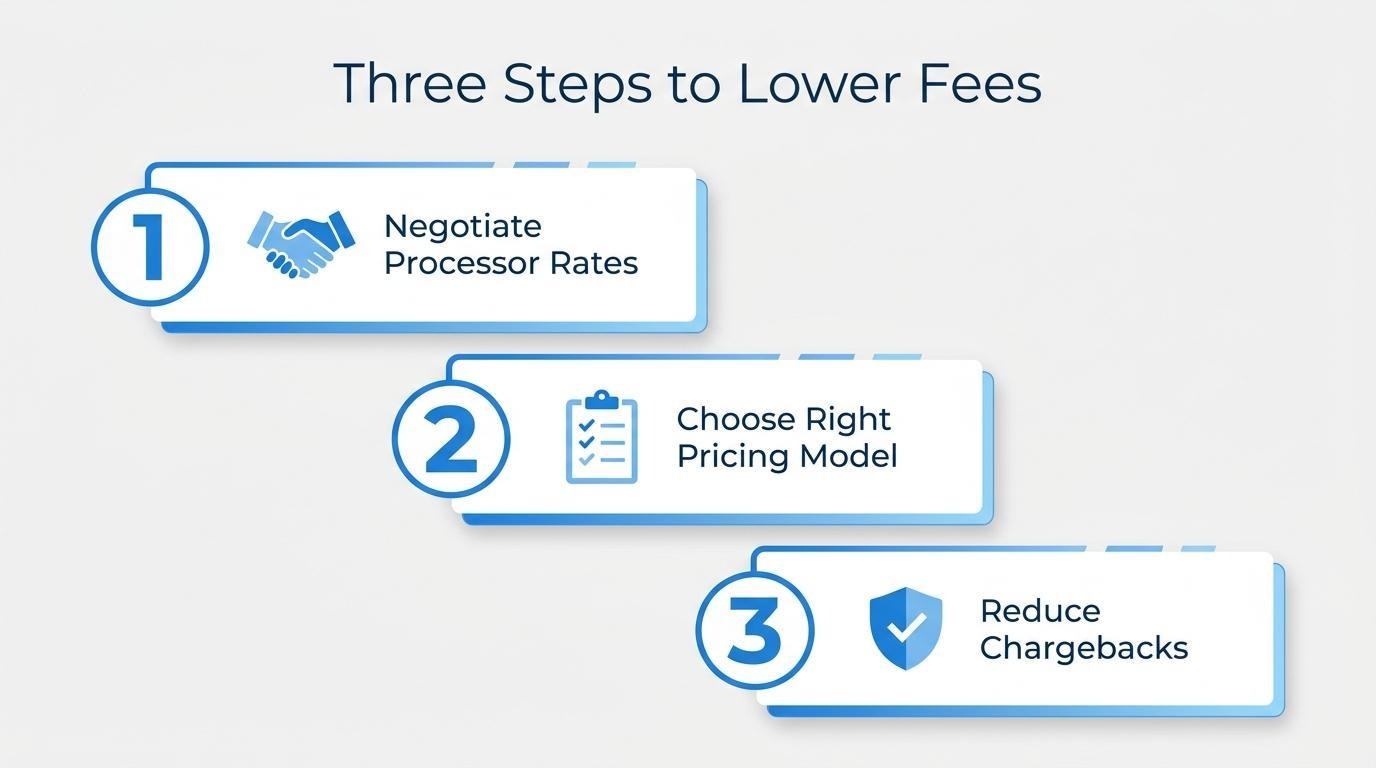
You can reduce merchant fees for your business by negotiating processor rates, choosing the right pricing model, minimizing chargebacks, and optimizing how transactions are processed. Each strategy targets a different fee component, from interchange costs to processor markups, and the combined effect can meaningfully lower your overall cost per transaction.
Negotiate with your payment processor. Processing rates are rarely fixed. Merchants with growing volume or strong transaction histories can request lower markup rates, reduced monthly fees, or waived incidental charges. Even small reductions in per-transaction markups compound significantly across thousands of monthly sales.
Choose a pricing model that fits your volume and card mix. Interchange-plus pricing offers transparency by separating interchange, assessment, and markup fees, making it easier to identify where costs accumulate. Flat-rate pricing simplifies budgeting but may cost more at higher volumes. Matching the model to your transaction patterns is one of the most overlooked ways to control fees.
Reduce chargebacks and fraud exposure. Chargebacks carry direct fees, often $15 to $100 per dispute, and excessive chargeback ratios can trigger penalty programs with even higher rates. Implementing fraud detection tools, clear return policies, and accurate product descriptions prevents disputes before they start.
Additional strategies that lower merchant fees include:
For most scaling merchants, the single highest-impact move is switching from tiered or flat-rate pricing to interchange-plus once monthly volume justifies it. Tiered models tend to route a disproportionate number of transactions into mid-qualified and non-qualified categories, which quietly inflates costs. Transparency into the actual interchange rate paid per transaction gives merchants the data needed to optimize further.
With fee reduction strategies in place, the next consideration is how those savings compound as transaction volume scales.
Merchant fees affect profit margins at scale by compounding across every transaction, turning small per-sale costs into significant annual expenses that erode net revenue. The subsections below cover cumulative cost impact, margin pressure by business model, and fraud-related losses.
Small per-transaction fees compound into major annual costs because each percentage point applies to every sale, and volume amplifies the total. According to The Nilson Report, U.S. merchants paid a record $187.20 billion in processing fees in 2024, tied to $11.903 trillion in purchase volume on credit, debit, and prepaid cards. At scale, a brand processing $10 million annually at a 1.57% weighted average loses over $157,000 to fees alone. Those dollars come directly off the top line before operating expenses, payroll, or inventory replenishment are factored in. For growing brands, this cost scales linearly with revenue, meaning fee optimization becomes more critical as volume increases.
Low-margin businesses face greater fee pressure because processing costs consume a larger share of each sale's profit. A product sold at a 10% margin loses roughly one-sixth of its gross profit to a 1.5% processing fee, while a 50% margin product loses only about 3%. Categories such as groceries, consumer electronics, and commodity goods operate on thin margins where even basis-point differences in fees reshape quarterly profitability. This makes pricing model selection, whether interchange-plus, flat-rate, or subscription-based, a strategic decision rather than an administrative one. Brands scaling past $1 million in annual revenue often find that renegotiating processing terms or consolidating payment infrastructure yields more bottom-line impact than incremental marketing spend.
Fraud losses add to the true cost of payment processing by layering chargebacks, investigation overhead, and lost merchandise on top of standard fees. According to the Federal Reserve's 2023 data, merchants absorbed 49.9% of losses from fraudulent transactions reported by covered issuers, up from 38.3% in 2011. This growing merchant liability means fraud costs are no longer a distant risk managed primarily by card issuers. Each chargeback typically carries a flat penalty fee on top of the reversed transaction amount, and excessive chargeback ratios can trigger higher processing rates or account termination. At scale, fraud prevention tools and chargeback management become essential line items, not optional add-ons.
Understanding how fees compound at volume helps clarify why integrated payment visibility matters across channels.
Managing payments and fees without a multi-tool stack changes by centralizing transaction data, fee reporting, and channel reconciliation inside one system. The following sections cover how SHOPLINE approaches this and the key merchant fee takeaways from this article.
SHOPLINE handles payment and fee visibility across online, POS, and subscription channels by unifying transaction records into a single backend. Instead of reconciling separate reports from a payment gateway, a POS provider, and a subscription app, merchants see all fee data tied to one customer record and one order history.
This matters because fee structures shift by channel. In-store PIN debit transactions carry different interchange costs than online credit card payments, and subscription billing introduces recurring authorization fees. When these live in separate tools, spotting discrepancies or hidden markups requires manual cross-referencing. A unified system surfaces every line item, from interchange to processor markup, in one place.
According to the Board of Governors of the Federal Reserve System, fraud losses across all covered issuer transactions in 2023 reached 17.6 basis points, or $17.63 per $10,000 in transaction value. For brands selling across multiple channels, consolidated fraud monitoring alongside fee tracking reduces the risk of absorbing costs that could otherwise go unnoticed in a fragmented stack.
The key takeaways about merchant fees covered in this article are:
For scaling brands juggling online, in-store, and subscription revenue, the ability to see all fee components in one view is often the difference between margin leakage and informed cost management.