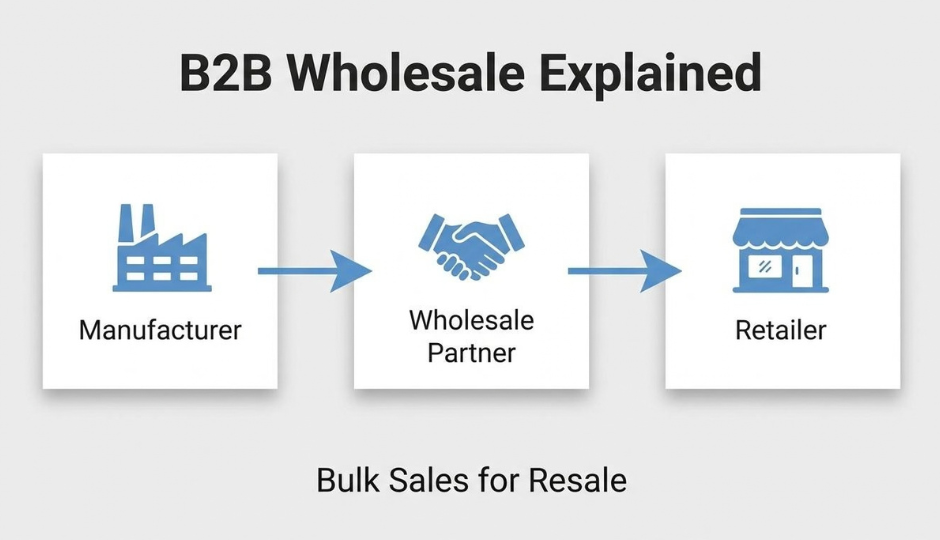
B2B wholesale is the sale of goods in bulk to licensed retailers, distributors, or other businesses for resale rather than direct consumption. It operates on larger order volumes, negotiated pricing, extended payment terms, and long-term buyer relationships that distinguish it structurally from selling individual units to consumers.
This guide covers the wholesale channel's strategic advantages, core business models, pricing and order economics, the operational steps to launch, ecommerce platform requirements, and common scaling challenges with solutions.
Wholesale creates revenue predictability through recurring bulk orders from retail partners who reorder on consistent cycles. It simultaneously lowers customer acquisition costs because retailers handle end-consumer marketing at their own expense, making it one of the most capital-efficient growth levers for brands with proven product-market fit.
The primary B2B wholesale models include traditional distribution through intermediaries, direct-to-retailer selling, online marketplace selling through proprietary or third-party platforms, and hybrid operations that combine DTC with wholesale under one brand. Each structures the manufacturer-to-buyer path differently, with distinct margin profiles and operational requirements.
Wholesale pricing typically works backward from retail using standard markup ratios, with tiered volume discounts rewarding larger orders at defined quantity thresholds. Minimum order quantities must cover per-order fulfillment costs while remaining accessible enough to onboard new retail accounts.
Launching requires validating demand through direct retailer conversations, building a structured product catalog, vetting buyers for creditworthiness, and establishing payment terms that protect cash flow. Brands running both DTC and wholesale benefit from unified commerce platforms that sync inventory, pricing, and order management across channels within a single system.
Common wholesale challenges, including channel conflict, cash flow gaps from net payment terms, and inconsistent branding across partners, each have structured solutions that protect margins and retailer relationships as operations scale.
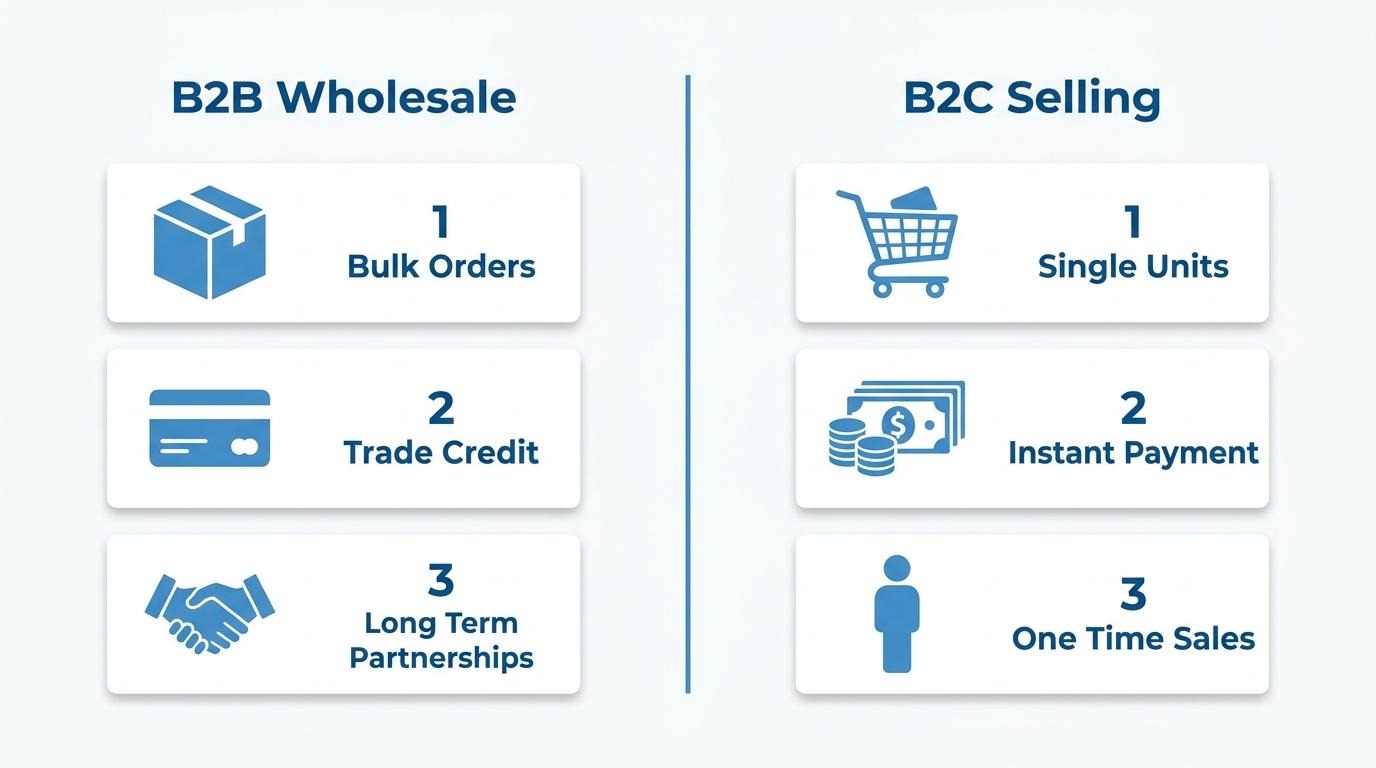
B2B wholesale differs from B2C selling in buyer type, order size, pricing structure, and purchasing process. The core differences span transaction volume, decision-making complexity, payment terms, and relationship duration.
B2B wholesale involves selling goods in bulk to licensed retailers, distributors, or other businesses for resale. B2C selling delivers individual products directly to end consumers. According to the Alabama Department of Revenue, wholesale sales are "sales of tangible personal property to licensed retail merchants, jobbers, dealers, or other wholesalers for resale," while retail sales go directly to consumers not purchasing for resale.
Key differences between B2B wholesale and B2C selling include:
For brands already selling direct-to-consumer, understanding these structural differences is essential before layering in a wholesale channel. The higher order values and predictable reorder cycles that define B2B wholesale create a fundamentally different operational rhythm compared to individual consumer sales.
Brands add a B2B wholesale channel to stabilize revenue, reduce marketing spend, expand reach, and move inventory faster. Each benefit compounds over time as the retailer network grows.
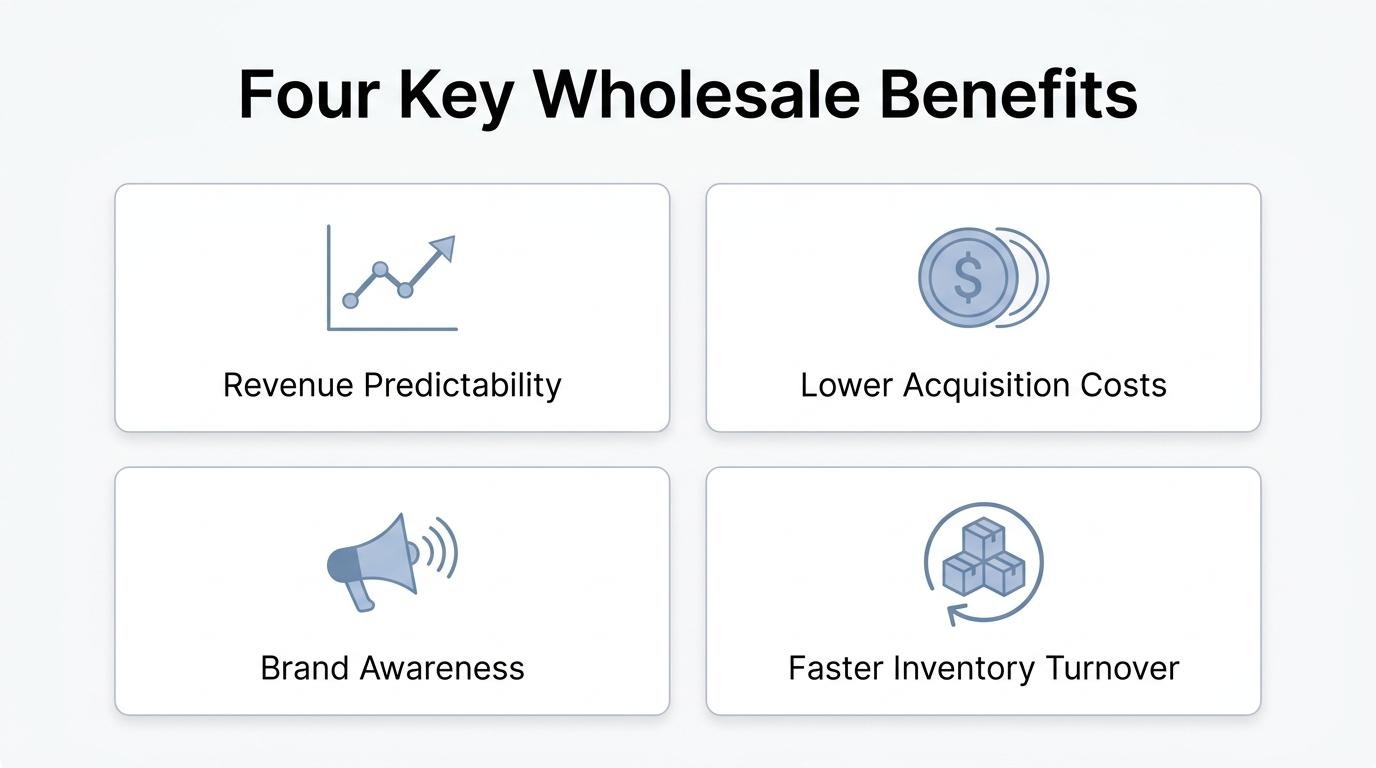
Wholesale increases revenue predictability by shifting sales volume from one-off consumer transactions to recurring bulk orders from licensed retailers. As the Alabama Department of Revenue defines it, wholesale sales are sales of tangible personal property to licensed retail merchants, jobbers, dealers, or other wholesalers for resale, distinct from retail sales made directly to consumers.
This structural difference matters. Retailers reorder on predictable cycles tied to their own sell-through rates, which creates a baseline of forecastable demand. Instead of relying on fluctuating ad performance or seasonal consumer traffic, brands with an established wholesale channel can project revenue against committed purchase orders. For scaling DTC brands already managing complex operations, this predictability simplifies everything from production planning to cash flow management.
Wholesale lowers customer acquisition costs by transferring the bulk of end-consumer marketing to retail partners. Each retailer who carries your product markets it to their own audience at their own expense.
According to Dr. Robin G. Brumfield of Rutgers Cooperative Extension, the biggest advantage of wholesale is larger potential transaction size and volume, while "someone else does most of the marketing" and "promotional/educational costs are low." A single wholesale account can generate the revenue equivalent of hundreds of individual DTC orders, yet the cost to acquire that account is a fraction of the combined spend needed to reach those consumers directly. This makes wholesale one of the most capital-efficient growth levers available to brands that have already proven product-market fit.
Wholesale accelerates brand awareness by placing products in physical and digital retail environments that brands could not reach through their own channels alone. Every retail shelf, online marketplace listing, or boutique display introduces the brand to a new customer segment without requiring direct ad spend.
Retailers bring built-in foot traffic, established customer trust, and local market credibility. When a product sits alongside recognized brands in a curated store, it benefits from an implied endorsement that no amount of paid social can replicate. This exposure compounds as more retailers carry the product across different regions and demographics, creating organic brand recognition that feeds back into stronger DTC performance over time.
Wholesale improves inventory turnover by adding a high-volume sales channel that moves larger quantities per transaction than direct-to-consumer orders. Bulk purchasing from retail partners clears stock faster, reducing warehousing costs and the risk of dead inventory.
A study published in the Journal of Business Logistics, analyzing 143 U.S. firms that implemented an online channel between 1996 and 2008, found that adding an online channel leads to measurable improvements in inventory turnover. Pairing wholesale with a digital B2B storefront amplifies this effect by giving retailers 24/7 ordering access, which shortens reorder cycles and keeps products moving consistently through the supply chain.
With these operational advantages established, the next step is understanding which wholesale business model fits your brand.
The main B2B wholesale business models are traditional distribution, direct-to-retailer selling, online marketplace selling, and hybrid DTC-wholesale operations. Each model structures the path from manufacturer to buyer differently.
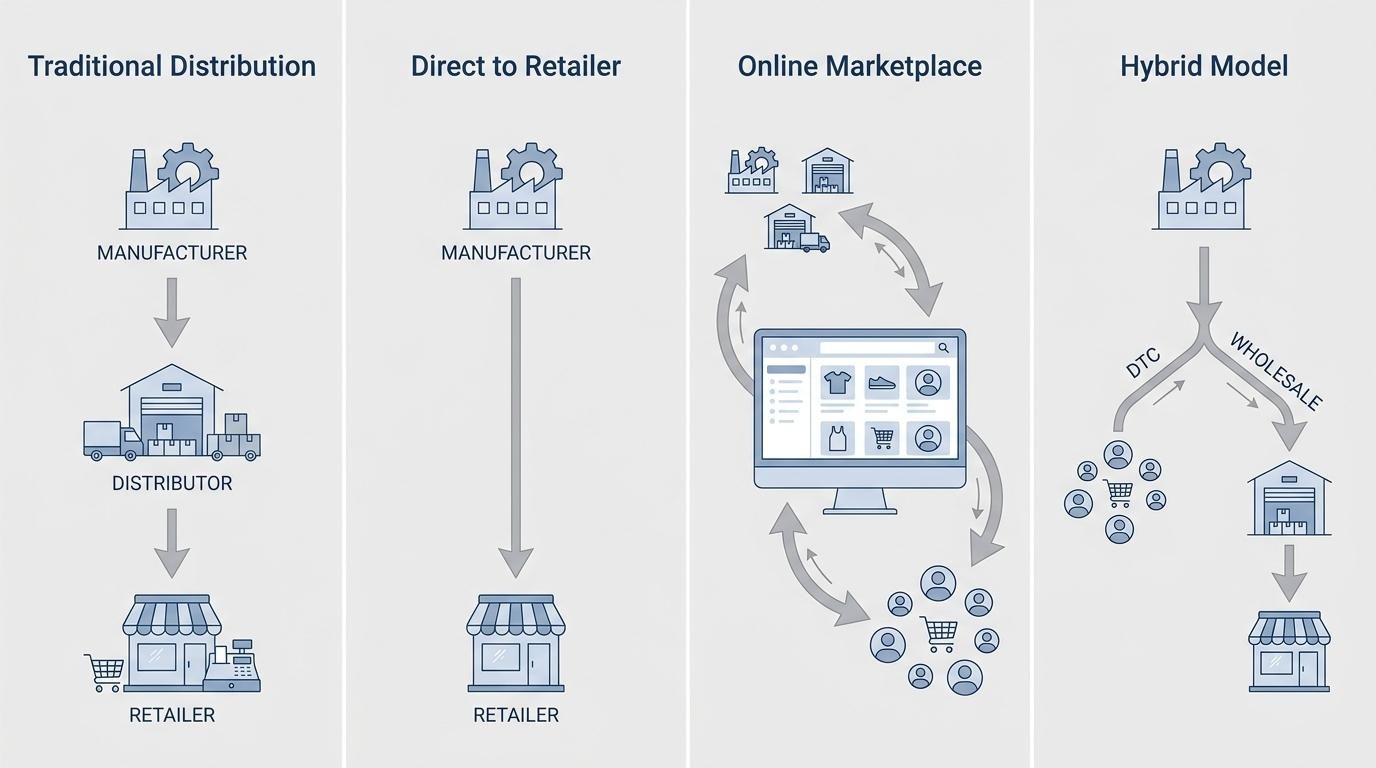
Traditional wholesale distribution routes products through intermediary distributors who purchase inventory in bulk from manufacturers, warehouse it, and resell to retailers or other businesses. The distributor assumes inventory risk, manages logistics, and maintains relationships with downstream buyers. This model suits manufacturers that lack the infrastructure or sales force to reach fragmented retail markets directly. Margins per unit are typically lower because each intermediary layer takes a cut, but the tradeoff is reduced operational burden on the manufacturer. Brands validating demand before committing to this model should gather direct market feedback; as the Warrington College of Business at the University of Florida advises, sellers need proof that target customers will value their product.
Direct-to-retailer wholesale eliminates intermediary distributors by selling bulk inventory straight to retail buyers. Manufacturers or brand owners negotiate pricing, minimum order quantities, and delivery terms with each retailer. This model preserves higher margins because no middleman takes a share, and it gives the seller greater control over brand presentation and partner selection. The tradeoff is operational complexity: the wholesale seller must handle sales outreach, order management, invoicing, and fulfillment internally. Direct-to-retailer wholesale works best for brands with an established product line, dedicated sales capacity, and enough demand to justify managing multiple retail accounts without distributor support.
Online B2B marketplace selling uses digital platforms to connect wholesale sellers with buyers. According to a study published in the Review of Managerial Science (National Library of Medicine), manufacturers can sell directly through a proprietary website, use specialized third-party platforms that act as a marketplace by charging a service fee, or distribute goods to online players that resell to end customers. Each approach carries different cost structures and levels of buyer control. Proprietary sites maximize margin but require traffic generation. Third-party marketplaces offer built-in buyer audiences at the cost of platform fees. Choosing between these paths depends on the seller's brand maturity and willingness to invest in digital infrastructure.
Hybrid DTC and wholesale combines direct-to-consumer sales with bulk B2B distribution under one brand. The brand sells at retail prices through its own storefront while simultaneously supplying retailers at wholesale pricing. This model maximizes revenue by capturing both margin tiers, though it requires careful pricing strategy to avoid channel conflict. Separate pricing structures, exclusive product lines, or region-based allocation help protect retail partners from feeling undercut. For scaling brands, consolidated platforms that manage both DTC and wholesale operations within a single system reduce the data fragmentation that often surfaces when running separate tools for each channel.
With business models clarified, understanding who participates in each transaction reveals how these relationships function in practice.
The key players in a B2B wholesale transaction are manufacturers, wholesale distributors, agents and brokers, and retail buyers. Each role serves a distinct function in moving goods from production to the end consumer.
Manufacturers produce finished goods and sell them in bulk. They set base pricing, establish minimum order quantities, and may sell directly to retailers or route products through intermediary channels.
Wholesale distributors purchase large volumes from manufacturers, then warehouse and resell those goods to retailers or other businesses. They handle storage, logistics, and often extend trade credit to buyers.
Agents and brokers negotiate contracts on behalf of other parties without taking ownership of inventory. According to the U.S. Census Bureau, agents and brokers typically earn a commission or fee for their services and do not take possession of, or title to, any goods. Their value lies in market access and relationship networks.
Retail buyers are the purchasing professionals within retail organizations who select products for resale to consumers. Business buying decisions are typically collective, involving several individuals with different levels of authority and technical expertise within the organization. This means wholesale sellers rarely negotiate with a single decision-maker; instead, they must satisfy procurement teams, category managers, and sometimes finance departments.
Understanding these roles matters because each player influences pricing, payment terms, and order fulfillment differently. A brand selling through a distributor, for instance, accepts a lower margin in exchange for broader market reach and reduced logistics burden. Selling direct to retailers preserves more margin but requires the brand to manage buyer relationships and shipping independently. Recognizing how these players interconnect helps brands choose the right wholesale model for their scale and operational capacity.
The products and industries that work best for B2B wholesale span both durable and nondurable goods sectors. Key categories include food and beverage, apparel, industrial supplies, health and beauty, and home goods.
B2B wholesale suits any product category where retailers need consistent, bulk replenishment. The strongest wholesale candidates share a few characteristics: predictable repeat demand, margins that support tiered pricing, and standardized specifications that simplify bulk ordering. Products with high per-unit shipping efficiency and long shelf stability also perform well, since they reduce logistics friction for both seller and buyer.
According to the U.S. Bureau of Labor Statistics, labor productivity in wholesale trade grew 4.4 percent in 2025, with durable goods wholesalers rising 3.6 percent and nondurable goods wholesalers rising 3.9 percent. That productivity growth reflects how well-structured wholesale operations scale efficiently across product types.
The industries with the strongest B2B wholesale fit include:
Products that struggle in wholesale typically have highly customized configurations, extremely low margins that cannot absorb volume discounts, or unpredictable demand patterns that make minimum order quantities impractical for buyers. For brands evaluating whether their catalog fits wholesale, the clearest signal is whether retailers already ask to carry the product, since organic buyer interest validates wholesale viability before any infrastructure investment.
Understanding which products fit the wholesale model lays the groundwork for pricing them correctly.
B2B wholesale pricing requires balancing healthy margins with competitive rates that attract retail buyers. The sections below cover calculating wholesale price from retail, structuring tiered volume discounts, and determining minimum order quantities.
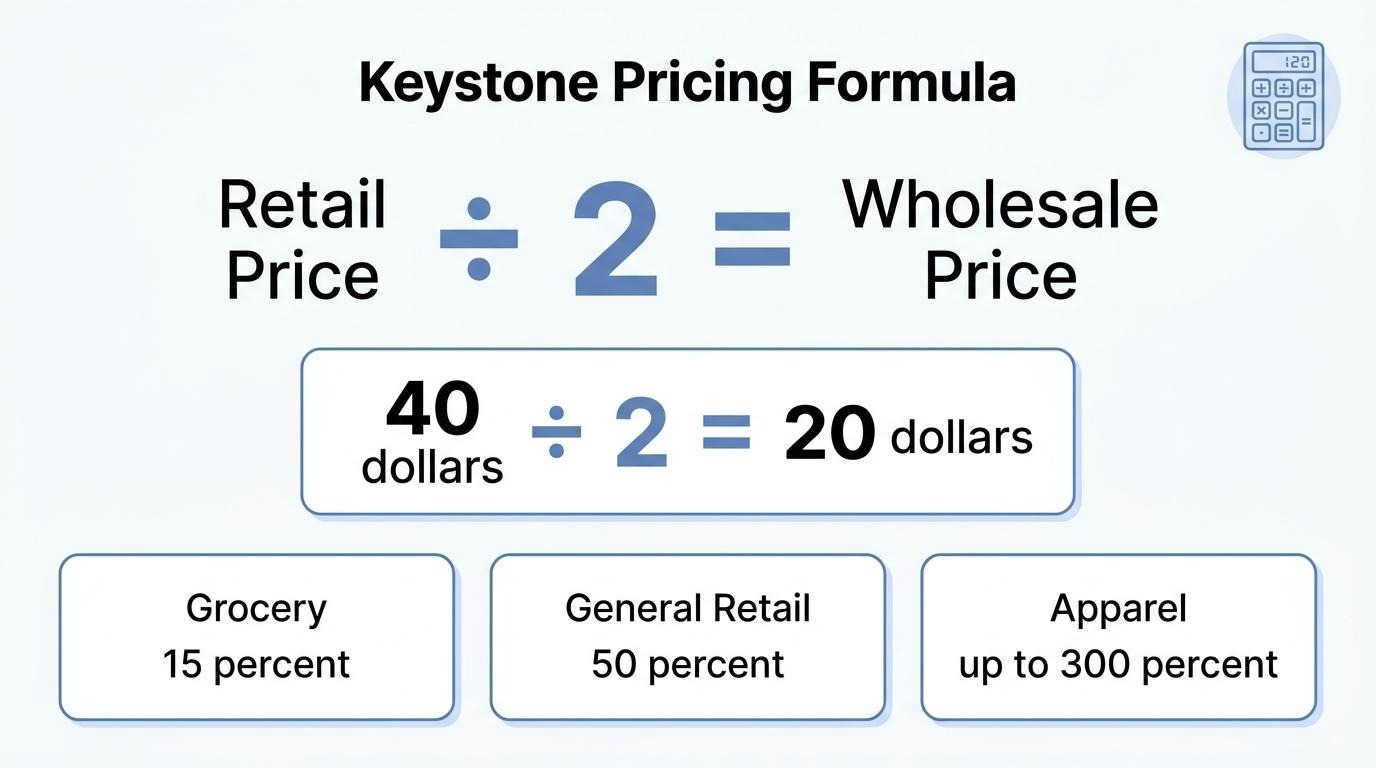
You calculate a wholesale price from retail price by working backward from the retail selling price using a standard markup ratio. The most common approach is keystone pricing, where the retail price is set at two times the wholesale cost. According to the University of Nebraska–Lincoln Extension, this 100% markup is so widespread that the term "keystone pricing" was coined specifically to describe it.
Markup percentages vary significantly by industry:
To find your wholesale price, divide your target retail price by the appropriate markup multiplier. If retail is $40 and the industry standard is keystone (2x), the wholesale price is $20. That wholesale figure must still cover your cost of goods, overhead, and a sustainable profit margin. For brands selling across multiple product categories, recalculating per SKU rather than applying a blanket multiplier protects margins on lower-volume items.
You structure tiered volume discounts by setting price breaks at defined quantity thresholds, where larger orders receive progressively lower per-unit costs. The underlying logic follows a total-cost model: as order volume rises, per-unit holding and ordering costs decrease, making it economically viable to pass savings to the buyer.
A standard tiered structure might look like this:
Order Quantity Discount Off Wholesale
50–99 units 0% (base wholesale price)
100–249 units 5%
250–499 units 10%
500+ units 15%
Each tier should reflect real cost reductions in production, packaging, or shipping. Offering discounts that exceed actual savings erodes margins quickly, so anchor every break to your fulfillment economics rather than competitor pricing alone.
You determine minimum order quantities (MOQs) by calculating the smallest order size that covers your per-order costs, including picking, packing, shipping, and payment processing, while maintaining a viable profit margin. An MOQ that is too high discourages smaller retailers from placing initial orders; one that is too low makes fulfillment unprofitable.
Key factors that influence MOQ decisions include:
Many brands set different MOQs for first-time buyers versus reorders, lowering the barrier for new accounts while maintaining efficiency on repeat purchases. With pricing and order thresholds established, the next step is building out the operational workflow to start selling wholesale.
The steps to start selling B2B wholesale include validating demand, building a catalog, setting prices, finding buyers, establishing payment terms, and organizing fulfillment. Each step below covers one stage of the launch process.
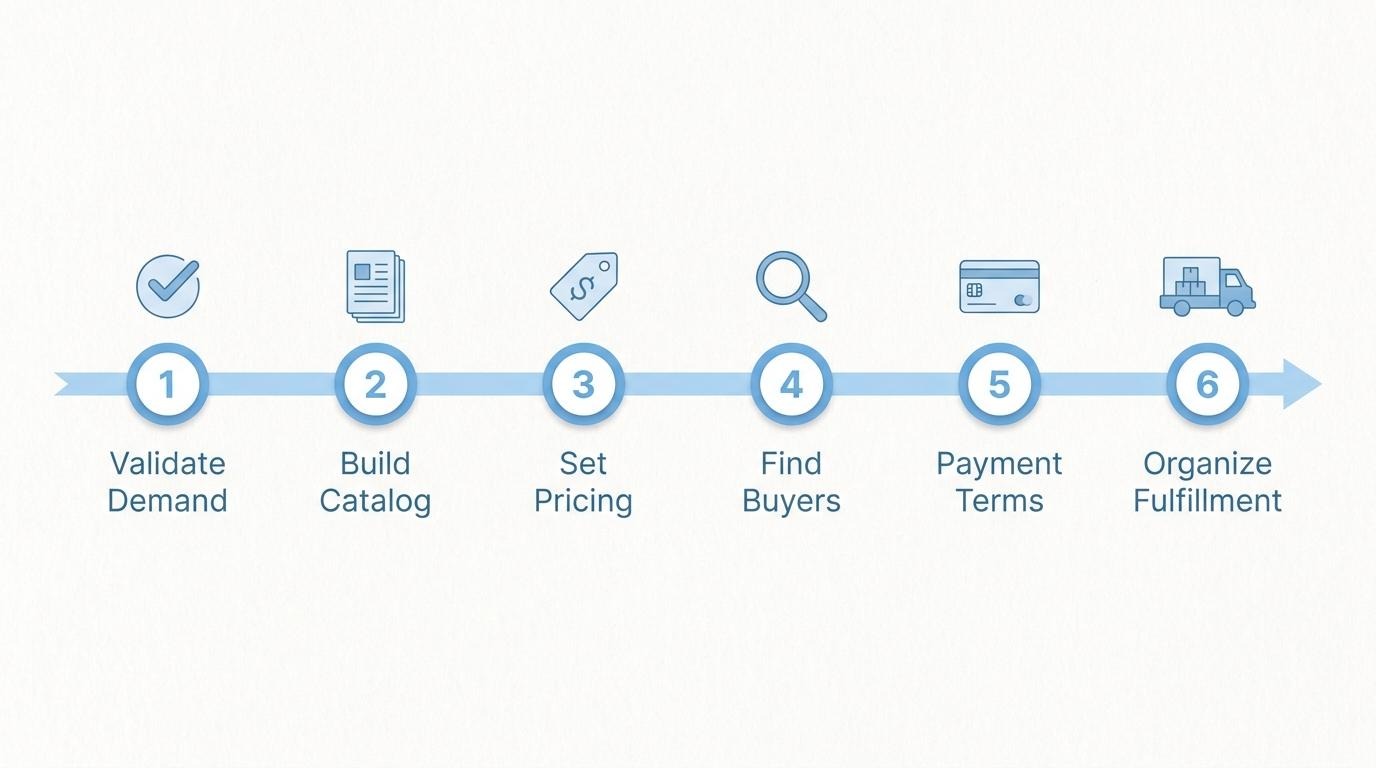
You validate wholesale demand for your products by gathering direct evidence that retailers want to stock and resell your goods before committing to bulk production. Start with these approaches:
According to the University of Florida's Warrington College of Business, entrepreneurs should ask: "What proof can you offer that your target customers will value your product or service?" Gathering that proof early prevents costly inventory missteps. For most brands, even five confirmed buyer conversations reveal whether wholesale margins and volumes justify the channel investment.
You create a wholesale product catalog by organizing your product line into clearly defined categories with standardized data that retail buyers can evaluate quickly. Each product listing should include:
According to the U.S. Bureau of Labor Statistics, labor productivity in wholesale trade grew 4.4 percent in 2025, reflecting how operational efficiency, including well-structured catalogs, drives sector performance. Strong product content also improves search visibility on B2B platforms. Separating durable goods from nondurable goods within the catalog helps buyers navigate faster and place larger orders with less friction.
You build a wholesale pricing sheet by listing every SKU alongside its unit cost, wholesale price, suggested retail price, and volume discount tiers. The sheet should clearly communicate:
Margins need to sustain profitability at every tier. A common starting point sets the wholesale price at roughly 50 percent of the retail price, leaving enough room for retailers to apply standard markups. Format the sheet as a downloadable PDF or a gated spreadsheet so buyers can reference it during purchasing decisions without back-and-forth emails.
You find and vet retail buyers by combining outbound prospecting with inbound qualification. Effective sourcing channels include:
Once prospects express interest, vetting protects your brand and cash flow. Request a business license, resale certificate, and at least two trade references. Check credit history through a business credit bureau before extending any payment terms. Evaluating a buyer's retail presence, including store locations, online channels, and brand alignment, ensures your products reach the right end consumers. Skipping this step is one of the most common mistakes new wholesalers make, often leading to unpaid invoices or brand misrepresentation.
You set up wholesale payment terms by defining when and how buyers must pay for orders. According to the Federal Reserve Board, trade credit arises when a business purchases goods or services for which payment is deferred. Common wholesale payment structures include:
Start new accounts on prepayment or net 15, then extend terms as trust builds. Clearly document all terms in a written wholesale agreement to reduce disputes and protect cash flow.
You fulfill and ship bulk wholesale orders by establishing warehouse processes, packaging standards, and carrier partnerships designed for high-volume shipments. Key fulfillment steps include:
Many retailers enforce strict receiving requirements, including specific pallet configurations, EDI-compliant advance ship notices, and labeled carton contents. Non-compliance often results in chargebacks that erode margins quickly. Investing in a warehouse management system that syncs inventory across wholesale and DTC channels prevents overselling and fulfillment delays.
With fulfillment systems in place, the right ecommerce platform keeps every wholesale operation connected.
A B2B wholesale ecommerce platform should have features that address the unique complexity of bulk selling to business buyers. The sections below cover password-protected storefronts, customer-specific pricing, real-time inventory syncing, and integrated order management.
A password-protected wholesale storefront is important because it separates wholesale pricing and catalogs from public-facing retail pages. This gating mechanism ensures only approved retailers, jobbers, and licensed buyers access negotiated rates and bulk product listings.
Without access controls, retail customers can view wholesale prices, which undercuts retail partners and creates channel conflict. Password protection also enables sellers to segment buyer groups, showing different catalogs or product lines based on account type. For brands running both DTC and wholesale from a single domain, this feature prevents pricing transparency issues that erode retailer trust. Most scaling wholesale operations treat storefront gating as a baseline requirement rather than an optional add-on.
You need customer-specific pricing capabilities because B2B buyers negotiate individual rates based on order volume, relationship tenure, and contract terms. A single price list cannot accommodate the variation that wholesale relationships demand.
Tiered and account-level pricing lets sellers assign unique price sheets per buyer or buyer group. This supports volume discount structures, regional pricing adjustments, and promotional rates for strategic accounts. According to the University of Nebraska–Lincoln Extension, retail price is typically two times the wholesale price, a pattern so common it has been branded "keystone pricing." When wholesale margins must flex around that benchmark, the platform needs granular controls. Static pricing forces manual workarounds, slows order processing, and increases errors across large buyer portfolios.
Real-time inventory syncing is critical for wholesale because bulk orders deplete stock rapidly, and overselling damages buyer relationships. When inventory data lags, a single large purchase order can promise units that no longer exist in the warehouse.
Synchronized stock levels across wholesale, DTC, and marketplace channels prevent double-selling and fulfillment delays. This is especially important for brands selling across multiple storefronts simultaneously. Accurate inventory visibility also helps buyers plan their own purchasing cycles, since wholesale procurement decisions often depend on confirmed availability. Platforms lacking real-time syncing force teams into manual stock checks, which slows order confirmation and introduces costly fulfillment errors at scale.
Integrated order management matters for B2B because wholesale transactions involve purchase orders, net payment terms, partial shipments, and reorders that consumer checkout flows cannot handle. A unified order management system ties these elements into one workflow.
Centralized order tracking reduces the manual coordination between sales, warehouse, and accounting teams. It also supports split shipments, backorder queuing, and invoice generation tied to agreed payment schedules. For brands operating both DTC and wholesale channels, integrated management ensures one order pipeline feeds a single fulfillment process. Without it, teams juggle spreadsheets and disconnected tools, which compounds errors as order volume grows. Platforms built around a shared data layer, such as SHOPLINE, handle wholesale order workflows inside the same system that manages DTC operations.
Common challenges in B2B wholesale include channel conflict between DTC and wholesale, cash flow gaps from extended payment terms, and inconsistent branding across retail partners. The sections below address each challenge with practical solutions.
You manage channel conflict between DTC and wholesale by differentiating pricing, product assortments, and promotional calendars across each channel. When both channels compete for the same customer on the same product at the same price, margins erode and retailer trust suffers.
The most effective approach is adopting an omnichannel framework rather than running siloed multichannel operations. According to a study published in Sustainability (MDPI), multichannel systems manage channels separately without integrated data, while omnichannel systems require integrated channels with cross-channel objectives and shared data. Brands that unify their channel data can set distinct wholesale-exclusive SKUs, enforce MAP (minimum advertised price) policies, and coordinate promotions so DTC and wholesale complement rather than undercut each other. For most scaling brands, the investment in channel integration pays for itself by preserving retailer relationships.
You handle net payment terms and cash flow gaps by strategically structuring when cash flows in and out across your customer portfolio. Extended terms like net 30, net 45, or net 60 are standard in B2B wholesale, but they create predictable liquidity pressure when payables come due before receivables arrive.
The U.S. Small Business Administration advises negotiating the longest payback terms possible with your own suppliers while simultaneously improving the speed at which wholesale customers pay. Practical tactics include:
Building a diversified customer portfolio with complementary payment cycles is often more sustainable than relying on credit lines alone.
You maintain consistent branding across retail partners by creating enforceable brand guidelines and providing retailers with ready-to-use assets. Without clear standards, product presentation varies wildly from one storefront to another, diluting brand equity and confusing end consumers.
Key steps to protect brand consistency include:
Brands that treat retailer onboarding as a brand education process, not just a sales transaction, see far fewer compliance issues long-term. With branding safeguards in place, the next consideration is choosing a platform that supports these wholesale operations at scale.
You should approach B2B wholesale on a unified commerce platform by consolidating DTC and wholesale operations into a single system with shared data. The sections below cover platform capabilities and key takeaways for getting started.
Yes, SHOPLINE's all-in-one ecommerce platform can support both DTC and B2B wholesale within a single system. SHOPLINE runs commerce, CRM, marketing automation, and order management from one shared data layer, so brands avoid stitching together separate tools for each sales channel.
Key B2B wholesale capabilities available natively on SHOPLINE include:
Because both channels operate on the same platform, wholesale order data and DTC customer data stay connected without third-party sync tools. For brands scaling past the point where app stacks create operational drag, this consolidation removes a common friction point. SHOPLINE is one option for merchants looking to manage wholesale alongside DTC without fragmenting their tech infrastructure.
The key takeaways about B2B wholesale benefits and getting started center on three areas: revenue impact, operational efficiency, and platform readiness.
The most overlooked factor when starting wholesale is platform choice. Brands that run DTC and B2B on separate systems inevitably face data fragmentation, manual reconciliation, and slower decision-making. Prioritizing a unified commerce platform from the start prevents these problems from compounding as order volume grows.